
Printed fromJewishThailand.com
ב"ה

"Shabbat Shalom from Bangkok"

chockablock full of inspiration

This is a note that came into my inbox.

We are a shomer shabbat couple now living in Jerusalem. We arrive in Bangkok …. we would like to organize Shabbat meals for Shabbat. My wife has some food issues (Gluten free/eats fish but no meat or chicken) and avoids nightshade vegetables (potatoes, peppers, tomatoes, aubergine, eggplant).

It reminded me of just how complex it is to be responsible for providing people’s nutrition needs.

Pause and think for a moment about the awesome kindness and largesse of Almighty G-d.

In Tehillim 136:25 King David sums it up when he offers the following praise to Hashem:

 Each and every day: He gives food to all flesh. God sustains all the creatures of the world, for His kindness is forever.

You think it’s hard to feed your family because one family member likes this and the other likes something totally different.

Think for a moment about the awesomeness of Hashem.

Hashem provides sustenance to ALL FLESH.

To humans with their eating requirements.

To the birds, the fish, the beasts and even to the bacteria.

This is one of the reasons that chapter 136 of Tehillim is called the ‘Hallel Hagadol’ the ‘Great Praise’. 

It is so easy to lose perspective and not open our eyes to see the unearned kindness that the Creator of all flesh bestows unto us.

Let us ask ourselves to take the following test.

The Parsha this week gives two scenarios about what happens when we eat and get full.

You will eat, be satiated, and bless God, your God, for the good land He has given you. (Devarim 8:10)

lest you eat and be sated and … your heart grow haughty and you forget God. (Devarim 8:12-14)

If you are up to it, make an honest appraisal.

What happens to you when you are ‘satiated’ riding a wave of success?

Do you feel more grateful, humble and mindful of the needs of others?

Do you do what G-d wants you to do with success. Which is clearly to find ways of sharing your blessings with those who are less fortunate. 

Or G-d forbid, does your hubris swell and you become more intolerant of others.

Does your swelling bank account now entice you to buying fleets of cars and other redundant excesses. 

Built into a Jew’s life is a reminder about Hashem’s grace and kindness. 

Every day we need to eat. After eating Hashem has instructed in the Torah that we thank Him.

The Birkat Hamazon – Grace after meals is one of the greatest prayers we say, albeit sometimes without enough kavana and meaning.

One of the very inspiring things about Jewish overnight and day camps is that they often sing the Birkat Hamazon in a melody that sticks in the mind of the child till they grow up.

I have met with people in their seventies who have forgotten almost all the prayers that they were raised with, but the Grace after meals is still fresh in their mind in the original Hebrew. 

Because of camp.

One should never underestimate the power of inspiring moment during ‘unofficial’ learning experiences. Like fun camps. The kids are having fun, living more Jewish and doing mitzvahs and learning Torah in an enjoyable way. Without the rigidity and ‘triggers’ of ‘school’.

The Rebbe encouraged the opening of camps for children as a way of inculcating Yiddishkeit in a most effective and joyous way.

The first Chabad camp started seventy years ago and was named Gan Yisrael. Today Gan Yisrael camps span the globe. 

I attended Camp Gan Yisrael as a child in Australia. 

We have several branches of Gan Yisrael camps here in Thailand during the summer which injects identity, knowledge and mitzvahs into the minds and hearts of the Jewish children in Thailand.

In the summers of 1990 and 1991 I had the great merit to be a head-counsellor in the flagship Gan Yisrael in upstate NY. The highlight of the camp was returning to Brooklyn with the entire camp and praying Mincha with the Rebbe. This was followed by the Rebbe giving an inspiring talk of about an hour and then handing us - the head counsellors – packets of dimes (10 cent coins) to distribute three to each child who attended the camp. One for Tzedakah, the other for themselves and the third was left up to the child to choose whether it would go to tzedakah or spent on themselves.
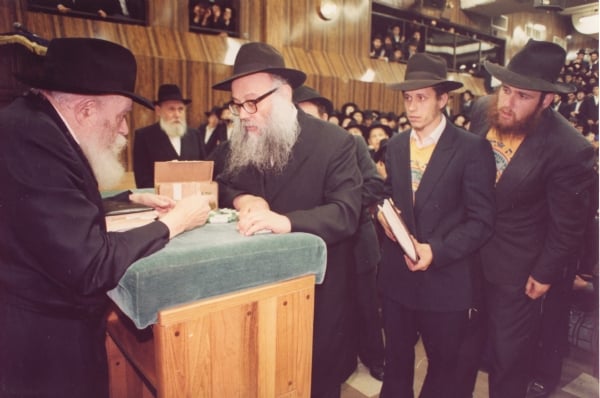
Receiving tzedakah from the Rebbe as a head-counselor in Camp Gan Yisrael

When I think back to that incredible experience and meditate on it I realize just how much emphasis the Rebbe put on Chinuch – EDUCATION.

And I recognize that however much Jewish educational opportunities there are, it’s not enough.

We need more and more Torah education for our children, and for ourselves, so that Judaism can thrive and grow.

Back to the beauty and importance of thanking Hashem after meals.

Here is the first paragraph of the Birchat Hamazon.

Blessed are You, L-rd our G-d, King of the universe, Who, in His goodness, provides sustenance for the entire world with grace, with kindness, and with mercy. He gives food to all flesh, for His kindness is everlasting. Through His great goodness to us continuously we do not lack [food], and may we never lack food, for the sake of His great Name. For He, benevolent G-d, provides nourishment and sustenance for all, does good to all, and prepares food for all His creatures whom He has created, as it is said: You open Your hand and satisfy the desire of every living thing. Blessed are You, L-rd, Who provides food for all.

A relatively short blessing. But so chockablock full of inspiration. 

Did you know that the author of this first paragraph of thanksgiving after food is Moshe Rabeinu?

What you may find even more breathtaking is that the food they were thanking G-d for, was the Heavenly Manna!!!!

It reminds us that while we may receive our bread in a more earthly way, through working and ‘hustling’, in reality it is really a gift from Hashem.

Let us become more grateful for the good that Hashem rains down upon us.

Especially, let us be more mindful of the greatest thing we can do in life.

Helping others!

Our Sages have told us we ought to cleave to Hashem by following in His ways, which is achieved by doing acts of benevolent kindness to others. Just as He does.

Appreciate your blessings more.

Give more to others.

May Hashem bless you with health, joy and nachas. As the Torah says, ‘if you bring joy to ‘mine’ (the unfortunates of society), I will bring joy to ‘yours’ (your loved ones).

As we are less than six weeks from Rosh Hashana let me get a headstart on that too.

SHANA TOVA,

Shabbat Shalom,

truth is the truth

As one gets older, I mean elderly to the point where they feel their days are numbered, they begin to think about leaving instructions for their loved ones.

They tend to be less cautious about giving criticism.

It actually is a very correct behavior. 

Moshe Rabeinu did this. 

As he was about to pass away, he gathered the Jewish people and spoke most of the book of Devarim – Deuteronomy. In the beginning of this week’s Parsha the tone of the speech includes a fair bit of constructive criticism.

At the end of the book of Bereshit the Torah relates how our ancestor Yaakov addressed his children before he passed away. The discussion was not only about the love and blessing he was transmitting to them. It also included some words of rebuke and reproach.

The Sages commented that there are various reasons for rebuking close to passing away. 

One of the most obvious reasons is the feeling that ‘if not now, when’?

Ironically, once the person has passed away, they can no longer speak. It is now his or her turn to be spoken about.

After a person passes away there are oftentimes speeches made in their memory. Eulogizing a departed person is very much about highlighting the special and praiseworthy attributes of the departed person. Not just because we want to honor their memory, but more importantly because we want to learn from them. We hope that the lessons they taught are inculcated by us and lead us to better behaviors. 

The things we talk about are meaningful. We don’t talk about how discerning a whiskey drinker they were, or how many Gucci handbags they owned. In highlighting the life of a person at a eulogy their kindness, commitment and piety is recalled. 

Talking about eulogies… I am reminded of a joke about eulogies.

A man once walked into the office of a rabbi who was quite well-known for delivering incredibly moving eulogies. Now, this man was, let’s say, exceptionally careful with his money. He wanted to plan ahead and save costs for his family, so he asked the rabbi, "Tell me, how much do you charge to speak at a funeral?"

The rabbi looked at him and explained that, like many things in the modern world, he had different options available. "We have the Platinum package. That is $10,000. Then we have the Gold package for $5,000, and our Standard package is $1,000."

The man, trying to calculate the value of every dollar, asked, "What do I get for the Platinum package?"

The rabbi replied, "Ah, for the Platinum package, I will pour my heart out. I will weep effusively, I will speak of your incredible deeds even if I need to stretch the reality a bit, and I guarantee you that by the time I am finished, there will not be a single dry eye in the entire synagogue."

"And for the Gold package?" the man asked.

"For the Gold," the rabbi said, "I will say very, very beautiful things about you. I will certainly shed tears myself, and a good portion of the congregation will be deeply moved to cry along with me."

The man thought about this. He thought about his wallet, and he wondered if he could push the limit even further. He looked at the rabbi and said, "Look, what if I only have $100 to spend? What do I get for $100?"

The rabbi smiled gently, looked him in the eye, and said, "Ah. For $100? For $100, I’ll just tell the truth."

Save your money.

The truth is the best.

Both in rebuke

And in eulogy.

Let’s learn from Moshe in this week’s parsha.

The following are the words that Moses spoke to all Israel on the east side of the Jordan River, regarding the sins they committed in the desert, in the plain, opposite the Sea of Reeds, in the Paran Desert, for having maligned the white manna, regarding the sins they committed at Chatzerot, and with their abundance of gold.

In each of these triggering mentions of places that they had sinned, there was also a subtly implanted defense and justification.

The one most obvious is reference to the ‘abundance of gold’.

This was a reference to the sin of the golden calf. It was really the worst of all sins, as it was an act of sheer idolatry a mere forty days after the greatest G-dly revelation of all times at Mount Sinai.

As bad as it was, Moshe was also presenting the context of why they fell into this horrendous mistake.

An abundance of gold. 

Moshe is hinting at the fact that drooling with gold and wealth is the backdrop that made them susceptible to sin.

It was not taking away their culpability for their bad choices. The Jewish people needed to ask G-d for forgiveness, and we are still wiping away the dirty smudges that obstinately seem to fade but not totally disappear.

Giving the context of having too much gold is taking away the sting and defiant betrayal that sinning conveys. Moshe is saying they were not intentionally rebellious, they simply fell into the trap of gold.

Rashi brings an example. If you put a young royal in a tempting situation with a purse full of gold coins around his neck, do you really expect him to withstand the advances and lures of the predatory sinners?

This is not a justification that whitewashes or allows the person to sin without conscience. If one is faced with forbidden temptation one needs to muster up every ounce of energy to fight and withstand it.

But Moshe was directing his reframing to the Almighty and offering a defense for the Jewish People. 

YOU, Almighty G-d, gave them the overabundance of gold. This created a great challenge. And alas your children have stumbled and feel regret. 

When you know the full truth, and all the circumstances, only then can you really know what the extent of the mistake was and what possibly caused the erring behavior. 

On the flip side. 

Overpraising someone when eulogizing them, especially embellishments that are not true, serve as no benefit to the soul. It is a great disservice.

Can you imagine the embarrassment one would feel if someone praised you for something you weren’t. Or gave you credit for something you didn’t do.

We need a balance as with everything in life.

When chastising or rebuking, (should be kept to a minimum and used sparingly) take the mitigating factors into account. Look at the whole picture, it may not be as negative as it seems.

And certainly, praise must be given. To those who are alive. And to those who have left us. 

To be proper, it must fit the reality not a wishful dream. 

I was thinking about this when hearing all the comments about the late Mrs. Myra – Esther bat Chaim Moshe – Borisute at her recent shloshim (30 day) memorial event.


Mrs. Myra was a remarkably powerful woman. Singlehandedly she raised six children in Bangkok when there was barely any organized Jewish life in the city and managed to get them all imbued with a true Jewish spirit which can be seen in her many observant grandchildren. Her enthusiasm for keeping kosher fueled her indefatigable cooking and baking sprees in her kosher kitchen which she shared with the community, for years being the de facto kosher bakery in town. Her determination and commitment to the mitzvah of family purity made her a fierce champion on behalf of the Mikvah that was built. Jewish afterlife care was so important to her that she worked tirelessly till we had a Jewish burial ground.

Listening to all the incredibly uplifting achievements made her sound so saintly.

Some of her family also painted her as a down-to-earth person with various challenges. Mentioning those challenges didn’t make her seem less noble. On the contrary, those handicaps could easily have torpedoed all of her remarkable achievements and notwithstanding that, she was a remarkable achiever in so many ways.

On a personal note, Mrs. Myra was one of those responsible for bringing Chabad to Thailand. Besides for her general financial support of the community there are some things that she gave us personally that really stood out. Her largesse and sensitivity got my wife a large American oven when it was almost unheard of in Bangkok. She gave me my first computer and printer as well as brought me into the world of mobile phones with a bulky Nokia when only the ‘bigshots’ carried personal phones (in her words ‘rabbi’s need to be reachable at all times..).

Mrs. Myra lives on through her children, grandchildren and a new great granddaughter born within a few days of her passing and named Esther for her. Her soul gets joy and nachas in the Jewish interactions and mitzvahs performed by the myriads of Jews who visit the chain of Chabad Houses and kosher infrastructure who owe thanks to her as one of Chabad’s earliest ‘investors’.

The truth is the truth. There is no need to shop around for a dressed-up eulogy. Once someone passes, they go to the world of truth. Only the truth ought to be told.

The following story will give you a way of thinking that you can copy paste to be used as a reframing tool when looking and judging others.

In a small Eastern European town, there lived a man named Berel. Berel was not a scholar, nor was he known for having refined manners. He was the town’s water-carrier, a physically grueling job that he did day in and day out. Over the years, the harsh winters and heavy yokes had taken a toll on him. He was known to have a very short fuse, a booming, gruff voice, and a sharp tongue that frequently flew off the handle when he felt slighted by the townspeople.

When Berel passed away, the town gathered for his funeral. The crowd stood in silence, wondering what the town Maggid (preacher) could possibly say about him. Everyone knew Berel's flaws; to paint him as a gentle, soft-spoken saint would be an obvious lie, an embarrassment to his soul in the Olam HaEmet—the World of Truth.

The Maggid walked up to the front, looked at the simple wooden casket, and began to speak the absolute truth:

"My friends, we all knew Berel. He was a man with a fiery temper. He yelled, he argued, and his words could be as biting as the winter frost. We cannot stand here and pretend he was a man of gentle speech."

A murmur went through the crowd. The Maggid was saying the plain, unvarnished truth. But then, the Maggid looked up toward heaven, his eyes filled with tears, and he shifted the perspective, providing the context:

"But Master of the Universe, let us look at why his shoulders were so tight and his temper so short. Every single morning, long before the sun rose, when the mud was thick or the ice was frozen solid, Berel was out there lifting heavy wooden buckets.

He didn't just carry water for those who could pay. He carried heavy buckets up the steepest hills to the homes of the poor, the sick, and the elderly widows of this town. He made sure they had water to drink and wash with before he took a single coin or a single sip for himself. His hands were covered in bleeding calluses, and his bones wrapped in constant pain.

You, Almighty God, gave him a life of crushing physical hardship. His gruffness was not out of rebellion or malice; it was the heavy sigh of a broken, exhausted body. Do not judge him by the sharp words he uttered when his feet slipped on the ice. Judge him by the freezing water he tirelessly carried for Your children with those very same calloused hands."

By the time the Maggid finished speaking, there wasn't a dry eye in the cemetery. He hadn't whitewashed Berel’s flaws; he had elevated them by revealing the reality of his struggle.

Hashem is True.

It is He who gives us our gifts. It is He who gives us our challenges. And it is He who truly knows what things are in our control and which are beyond.

As humans we need to be humble.

Even as successful, wildly successful, super-powerful and mighty as we may be, we can and ought to be humble. 

By one simple meditation.

‘Who gave me my success, my beauty, my money or my talent’?

The Almighty.

Did I live up to what I could have become?

Would someone else have done a better job utilizing my gifts?

Before you go to sleep take a moment to think about it.

And make the obvious resolution.

‘Let me try harder tomorrow’. 

As the code of Jewish Law says, ‘RISE LIKE A LION’ in the morning to do G-d’s will.

GOOD MORNING to you my fellow Lion. 

This morning you woke up. This means that G-d gave you back your soul. For a reason.

Go and make a difference in the world by studying Torah and doing Mitzvahs.

Lets bring Mashiach NOW, so that Tisha B’av (coming up this Wednesday sunset till Thursday evening) can be transformed from a fast day to a joyous feasting day.

Shabbat Shalom,

Rabbi Yosef Kantor


What am I needed for?

Have you ever found that when you finally arrive at a destination, it doesn’t seem quite as exciting as you imagined?

The anticipation and imagination of what it would be like at that yearned-for endpoint is often much more enjoyable as a vicarious goal than the actual reality on the ground.

It starts when we are children. Summer vacation is something we look forward to all year, eagerly counting down the days until the end of school. Yet, once the holidays actually start, children quickly begin complaining and whining about being bored. At some stage of the long break, many kids secretly look forward to resuming school (albeit they won't admit it when asked).

Is it any different with adults?

How often does someone pursue a goal—whether it’s wealth, influence, or a specific status—believing it will bring them happiness and personal fulfillment, only to discover that the reality requires a level of responsibility, commitment, and consistency they didn't bargain for?

I have watched people rise to financial wealth and then start to feel insecure, overburdened, and self-conscious—almost regretting their newfound success. As an elusive goal, money seems to be a ticket to happiness. So does fame. If you are an "influencer" trying to gain subscribers and followers on social media, you imagine that when you hit your goal of reaching millions of fans, you will be the happiest person around.

Yet, it doesn’t seem to be that way. Too many famous people are downright miserable.

This week, I was counseling one of my young Jewish friends who recently lost a friend of his. His friend was a well-known influencer who achieved fame and money before the age of thirty, but died prematurely due to a freak accident. Because of my indirect connection, I picked up on some posts this celebrity influencer had made not long ago. They indicated clearly that being incredibly popular and sought-after had not made his life happier or easier; rather, it made his life more challenging and filled with anxiety.

He deeply questioned his success. Did people really follow him because of who he was, or merely because he was a good actor?

This really jolted me. This was a person who regularly posted about topics he considered beneficial to his viewers. He wasn’t questioning whether he had provided value; he was disturbed and unnerved by the fact that he was not being "true" to his inner self.

And I ask: So what?

Is the most important thing in life to be who I think I should be, or to do what the Creator created me for?

I am fully aware that today’s society considers one of the most compelling missions of life to be reaching self-actualization, filled with a sense of meaning and purpose that spells happiness. In and of itself, it is noble to try to fulfill your potential. And generally, these two tracks are meant to be one and the same. G-d gives you talents and abilities and puts you in scenarios that all point to the mission He chose for you.

In a more general sense, when a Jew keeps Torah and Mitzvahs, it is the surest expression of self-actualization. It is the only recipe to achieve true, authentic, and deep happiness. G-d created us and gave us the "manufacturer's guide" to self-fulfillment, which is oneness with G-d.

Yet for some people, once they develop their potential, they start to feel an unease. This can lead to "losing the plot." It may even feel spiritually compelling to step out of G-d’s plans and seek an alternative spiritual destination.

This week’s Torah Parsha spells it out. Let me explain what I mean.

This week’s parsha refers back to the mistake and sin of the spies. They rejected going into Israel. Why? They had waited 210 years through exile and torture in Egypt to finally come out and be led to the Promised Land—a land flowing with milk and honey. Why did they reject it?

Because they sent spies to scout the land and bring back a report. In a sense, they got a glimpse—almost like a virtual reality look—at what living in the anticipated destination of Israel would actually look and feel like. And they didn’t like what they saw one bit.

The desert was spiritual bliss. They were surrounded by clouds of glory and ate manna from heaven. Entering Israel, however, meant they would have to work the land and live a fulfilling but mundane life.

"Not for us," said the spies. Most of the people agreed with them, preferring to stay in the desert.

We all know how that turned out. Hashem and Moshe were far from happy (to put it mildly) about the choice the Jews were making to avoid Israel. Where did they go wrong? They didn’t realize that the truest and deepest connection to the Divine would come through getting their hands dirty by tilling and working the soil. Hashem desired that the mitzvahs be fulfilled in a physical way, which could only be realized by entering the physical Land of Israel.

I am reminded of a similar scenario that happened with the Rebbe. It was during the large Purim celebration in 1955. The Rebbe asked who would want to be blessed with the gift of wealth. Out of the many hundreds in attendance, only a few people raised their hands.

Why didn’t more raise their hands?

Because although wealth is usually viewed as "rosy" and desirable, the Rebbe had first spoken at length about the immense responsibility and challenge of being wealthy. This shifted the mindset of the crowd from viewing money naturally—as a key to an easier, happier life—to viewing it as a powerful, demanding mission that carries psychological and spiritual challenges.

The Rebbe had described this reality with such vivid color that, in a sense, he had taken them on a "virtual journey" into the demands wealth places upon a person. In response, the crowd maturely demurred, hesitant to take upon themselves this harder path.

But the Rebbe was disappointed. Because that hesitation missed the point of what life is all about: to do what Hashem wants of us. Hashem wants us to use the wherewithal of money to be His treasurers here on earth—to perform acts of kindness, charity, and goodness. Even if it’s a more challenging path.

Let me tell you a story:

A Chassid once came to the Alter Rebbe with a list of personal struggles and needs, asking for a blessing. The Alter Rebbe looked at him and said: "You are highly concerned with what you need from the Almighty. But you haven't asked: What does the Almighty need from you?"

This single sentence, with all of its depth, penetrated the Chassid’s mind and heart so deeply that he fainted on the spot. It speaks perfectly to the tension that can sometimes exist between personal desire and divine mission.

Like in the case of the spies who preferred the spiritual sanctuary of the desert, where manna fell from heaven and their material needs were miraculously met. They feared that entering the Land of Israel meant losing their spiritual focus to grueling, physical labor. However, the Almighty wanted them to go and live a physical life in Israel.

Chassidic thought teaches that their sin was a bit more subtle than it seems. It was the mistake of choosing their own version of spiritual fulfillment over what G-d actually expected of them—which, of course, would have led them to an even deeper spiritual fulfillment than they could have foreseen.

The Rebbe was disappointed when the Chassidim didn’t opt-in to the blessing of wealth for the exact same reason. The Rebbe reminded us that wealth is a mission-oriented gift, given specifically to expand and enhance what one can do for G-d by helping others, even though it comes with immense challenges.

The same applies to influencers, or to people gifted in any of the multiple ways G-d bestows His blessings.

When we achieve success and then face unanticipated hardships at our destination, conventional wisdom tells us to ask, "Is this making me feel fulfilled? Am I self-actualizing to my greatest capacity?"

Torah wisdom teaches us that the question should not be "What am I getting out of this?" but rather, "What am I needed for? How do I serve G-d through this specific reality?"

I have found this question to be present among many people these days. I find it especially pronounced as people proceed into the more advanced decades of their productive lives (kind of ‘midlife crisis?), once major goals have already been achieved. A person "knows" they should be happy, but somehow, that anticipated happiness isn't there.

What should we do?

Sometimes a big change is needed. 

But often life just needs reframing. 

Ask not what makes me happy; rather, ask, "What am I needed for? What does G-d want of me?"

How do you know which is true in your case?

This is precisely why the instruction in Pirkei Avot, "Aseh lecha rav" ("Make for yourself a rabbi/mentor"), is indispensable. A mentor who holds the values of Torah-based morality provides an objective mirror. They help you look past the external illusions of success or the heavy fatigue of responsibility, guiding you back to your ultimate purpose. A mentor can help you look at yourself objectively so that you don’t run away from the responsibilities and gifts that G-d has entrusted to you.

If you are feeling a little disenchanted with what you are doing in life, before making a drastic U-turn, try this piece of Torah wisdom: Do a spiritual "checkup." Take counsel with a wise person who can guide you.

May we all be blessed with the ability to know and commit to G-d’s Divine plan for each and every one of us. This will reach its blissful peak with the coming of Mashiach, NOW.

AMEN.

Shabbat Shalom,

Rabbi Yosef Kantor

they are warmly welcome too

I’ve always wondered.

How do kids know that they can get away with misbehaving, that their parents won’t kick them out of the house?

In their friend’s home they act properly.

At school they maintain the decorum.

Why do they feel comfortable to be disrespectful at home?

Because they know their parents will tolerate them even if they don’t ‘toe the line’.

How do they know?

Same questions go to spouses. 

A man who would never ignore a colleague at work may remain engrossed in his hobby at home and not respond to his wife.

Or vice versa a woman who never raises her voice in the public arena may scream at the top of her lungs at home.

Why do people act differently with their own family than they do with outsiders?

It all boils down to the same point.

We have an inner compass that allows us to judge what kind of behavior will be tolerated in each differing environment.

That inner discerning voice tells the little child that if he acts out at my friend’s home, he won’t be invited back to a play date with his friend. 

Forward thinking and good planning for a child means that if I had a good time at my friend’s home and want to be allowed back for a play date, I had better tidy up the mess I made.

That same innate judgment assures the child that if he doesn’t clean up his mess at home, he won’t be kicked out of the house.

It’s the way it is meant to be.

Love, real love, needs to be far deeper than a transactional relationship.

And today we know more than ever that it is critical that our children don’t mistakenly think that if they are not perfect they will be ejected from home. 

In an ironic twist, in today’s day and age, many children subconsciously misbehave and act in a way they know is not causing nachas and pride to their parents because they crave the validation and knowledge that their parents love them even if they are imperfect.

Here in Thailand, we meet our fair share of young people who are testing the boundaries of their parent’s love. Rather than see them as rebellious, we ought to view them from the lens of understanding what they are truly intending, albeit subconsciously. By behaving differently than the expectations of their parents and of their close-knit religious communities they are digging deep to see if the love of their parents extends to them beyond boundaries. 

The parents of today have re-learned parenting and are starting to see this misbehavior as not being an act of defiant rebelliousness stemming from hatred. Rather there are issues related to childhood trauma, insecurities, phobias and a whole plethora of possible root causes that express itself in the behaviors and attitudes that challenge the parent child relationship. 

Often, by the parents digging deeply into their soul and igniting a love for their child, the relationship can be saved. It can even be rekindled and fanned to grow to a more passionate than average relationship with the child that was the most challenging. 

This topic is a very profound one and I have oversimplified but I trust that you hear my point.

It is not easy to actually live with this kind of love and it takes getting used to as it seems to run against traditional thinking and is certainly not instinctive. It needs to be learned and worked on.

It seems to be working.

From my observation and engagements with many differing styles of Jewish communities from all over the world (believe it or not Bangkok seems to be at the epicenter of many Jewish communities. A topic for an article in itself)  this way of thinking and behaving is currently yielding very powerful results in healing many fractured and compromised relationships. 

Which is why I found it intriguing and fascinating to read in this week’s parsha about Hashem’s instruction to Moshe regarding his appointment of Joshua as the successor of Moshe. 

Bamidbar 27:19  And you shall present him (Joshua) before Eleazar the priest and before the entire congregation, and command him in their presence to tolerate their stubbornness.

Rashi comments: And command him - about the Israelites: Know that they are troublesome and they are stubborn. You are given this position on condition that you accept this burden upon yourself.

I can understand that a Jewish leader needs to be reminded that the people may be stubborn and that part of his job is to accept them even with all their difficulties. 

But why does Hashem insist that this tolerance clause be done in the presence of the people?

Shouldn’t this be told in private to the leader that he should be ready for the challenges of disobedience? 

Wouldn’t it be more effective if the people would be instructed to be obedient without knowing that Hashem has already put it a clause that keeps them under the leadership of Joshua even if they misbehave?

The way Hashem instructed Moshe to transfer the leadership seems to almost be an invitation to the people to test the limits of their relationship with their leader.

Wouldn’t it best be done in a private conversation with the leader?

(see Ramban - Nachamides on this verse who raises these concerns and therefore offers a different meaning to the verse).

To me, it seems clear that Hashem wants both the leader and the community he is leading to know that their bond is consummate and unshakeable. 

That every single Jew hear the message that the connection of the Jew to Hashem and to Hashems servant Moshe (and all subsequent Jewish leaders) is unshakeable. Even when there is stubborn disobedience the bond is intact. It may be causing irritation and pain but the Jew is not severed from his ‘head’ the leader of the generation. 

This means that a Jewish leader needs to know that he is not just leading the righteous and obedient members of our people. The leaders need to be dedicated just as much (and perhaps even more) to the challenging children. 

And Hashem wants us to know from the outset that even if we are difficult, we cannot ever break our connection with Hashem and with Moshe His servant. 

The result will be that the children, the Jewish people will be more deeply connected to Hashem.

Just like a child loves his mother more than his friend’s mother. Even though he doesn’t clean up his toys when his mother asks while he does tidy up for his friends’ mother. Externally it may seem that his love for his parent is mitigated and limited. The reverse is true.

It is similar and even more existentially true when it comes to the relationship that every single Jew has with Hashem.

As I was dwelling on this message – which I only discovered this year after many decades of reading the weekly Parsha - I realized how Hashem was sending me a timely message that is so relevant to me  this very week in 2026 in Thailand.

The Bangkok Post chose to run the following article yesterday about a person who opened a ‘Bayit Chiloni’ – a ‘secular house’:

A group of secular Israelis has opened a community center on Koh Phangan, saying it wants to offer Israeli visitors to the tourist island an alternative to the “indoctrination” found at Chabad houses.

….

It has been set up directly opposite the local Chabad House on Koh Phangan….opposes the Chabad movement and the concept of Chabad houses abroad, Naor Narkis, a secular Zionist activist and politician, told the Jerusalem Post…. 

Chabad houses are informal Jewish community and outreach centres operated by the Chabad-Lubavitch movement. They function as a “home away from home” for Jewish travelers, students and residents, offering religious services, classes, counselling and communal meals.

There are six Chabad houses in Thailand: in Bangkok, Chiang Mai, Phuket, Koh Samui, Koh Phangan and Pai.

“Religious organizations are present everywhere Israelis are found; their strategy is transparent and clear — and I’m so happy that a secular foothold is now being planted thousands of kilometers away from Israel in order to strengthen secular identity,” Mr Narkis said.

It is so preposterous that it is hilarious. 

To call a Jew a ‘secular’ Jew is blending two different kind of descriptives that don’t use the same currency.

‘Jew’ is a religious term. Secular is a description of how you behave. You are either Jewish by G-d’s definition (born to a Jewish mother, or converted according to Halacha) or you are not Jewish. 

Some Jews don’t express their holiness and G-dliness as much as their potential allows. Some Jews try harder to express their inner core self as a Jew. 

Tzvi Freeman puts it like this:

In modern-day jargon, the term "Orthodox" has come to designate those of us who don't change  Torah just so it should fit in better with what everyone else is doing. In that sense, I definitely count myself among the "orthodox." But I sure don't feel orthodox. Should I?

That's another thing the  Lubavitcher Rebbe said: "Labels are for shirts." Okay, there are other things that can take labels. Like Reform Temples, Conservative Synagogues. But the Jews that you'll find in these places have all just one label: Jews. Because "Jew" is not a behavioral term. It's an essential state of being. It's not where you're at, it's where you belong.

So if anyone should ask you to describe the three kinds of Jews today, answer as follows:

There are three types of Jews:

  1. Jews who do mitzvahs.

  2. Jews who do more  mitzvahs.

  3. Jews who do even more mitzvahs.

And that's about it, because a Jew can hardly breathe without doing a mitzvah.

Click here for full article

Of all weeks to meet up with such a ridiculous press conference, Hashem sent me a message tin the Torah Parshah to guide me on how to react.

With LOVE.

Some 3300 years ago, Hashem has already preinformed us about the stubbornness of some of our people. 

Yet, the Jewish leaders in an unbroken chain from Moshe, Joshua, till the Rebbe in our generation, have been instructed to be the head and leader of these ‘wayward’, ‘stubborn’ and ‘misguided’ fellow Jews as well at the more devout ones.

This is why the Chabad House in Koh Pangan, like every Chabad House in the world, founded by the Rebbe to be a home of unconditional love for every Jew, is not getting offended and is not putting up barriers. Rather we are warmly welcoming all Jewish including those activists of the so called ‘secular house’ to uncover their true identity and join for Shabbat, to pray, eat, study and congregate together with love and inclusivity.


Chanukah Candle lighting at Chabad Koh Phangan

My friends and colleagues around the world have reached out to me wondering how this is impacting our work.

I responded that this group has done us a great service.

The outpouring of support for the Chabad House in Ko Pangan is incredible. Someone even called to donate funds to expand our school there. So that we can have room for more students in our ‘waiting-list-only’ Chabad preschool in the island.  

Graduation last week at Chabad Koh Phangan's preschool.

This is the Rebbe’s version of responding to darkeness. Adding more light.

But in terms of anti-israel and anti-Jewish sentiment, this ‘secular’ activist has harmed the Israeli community living in Thailand at a time when we are already so vulnerable. 

A local veteran journalist asked me ‘why did the Bangkok Post share this story, it is not newsworthy in an international sense’?” 

I think it is obvious. It delights our enemies. It portrays us as confused people. The bad press about Israel’s and Jews is fed by such eccentric shenanigans about people who can’t even seem to get along with each other

However much we inside the Jewish community know that it is silly and bizarre to open up a ‘secular house’ (there are plenty of unholy venues in Thailand already, I don’t think you need a rabbi to tell you that…), our enemies have a field day with this kind of article. 

Let me be very clear.

As misguided as they are, they are our Jewish brothers and sisters who are waiting for their souls to proclaim with pride 

SHMA YISRAEL AD text-decoration: revert; color: rgb(102, 102, 102); line-height: 30px; background-color: rgb(255, 255, 255);open sans", "helvetica neue", helvetica, arial, sans-serif !important;">This week’s Parsha proclaims loud and clear that G-d loves each and every Jew so much that He makes it compulsory on the leader to let the troubled rebellious Jew know that he or she will always be loved and cared for by the leader.

During these ‘Three Weeks’ as we remember the destruction of the temple in Jerusalem nearly two thousand years ago, which was facilitated and caused by our inner baseless hatred for each other, we need to bring about the redemption by acts of pure unearned love for each other – Ahavat Yisrael with no boundaries.

May we merit to love each other, to love G-d and to love His Torah and welcome the Mashiach NOW. AMEN

Shabbat Shalom,

Rabbi Yosef Kantor

Looking for older posts? See the sidebar for the Archive.