Printed fromJewishThailand.com
ב"ה

"Shabbat Shalom from Bangkok"

Do you feel blessed?

Our Parsha is called ‘Re’eh’ which means ‘see’. 

The Parsha begins ‘See, I am placing before you blessing…’. The ‘I’ in the verse is Hashem.

Do you feel blessed?

You may be surprised to hear this. Not everyone feels that they are blessed. 

The words of the Torah ‘SEE I place before you blessing’ are an invitation and a ‘coaching’ instruction to open your eyes and make an effort to truly ‘see’ and appreciate the blessings that G-d has given you in your personal life. 

So often, all it takes for us to feel happier and more contentment is to open our eyes and ‘see’ and appreciate the blessings of G-d.

In our family, my wife Nechama has started a tradition of going around the table during family meals and asking every participant to give thanks to Hashem for something specific. 

I urge you to try it. What you will notice immediately is that it does not always come automatically. Some people struggle with trying to articulate what they thank Hashem for. Verbally articulating personal thanks to Hashem for something specific is a great way to upgrade your feelings of blessedness and gratitude to the Almighty. 

When you know that you will be called upon to describe your appreciation to Hashem, you start paying more attention and ‘seeing’ the blessings.  

Perhaps the meditation below can help.

A statistic I once read has stayed in my consciousness as it sounded quite frightening. 

A survey taken in the USA showed that 59% of Americans are one paycheck away from being homeless.

Having a home is one of the primal needs of a person. Being displaced from one’s home and ‘out in the street’ is a real fear for those who cannot pay their rent. 

I know this because people contact me for help from our community Tzedakah fund when they need urgent help. I sense fear in their voice when they describe their fear of being evicted by a landlord who has lost his patience with their inability to pay their rent on time. Being able to have a consistent roof over one’s head is uppermost in the list of human needs.

Come to think of it there is something much scarier which we don’t often think about which we don’t need a survey for. We all know it from observing life around us.

Health and life itself.

We have all heard of cases when someone who was young and healthy suddenly was not. 

100% of humans are just one microbial infection, one blood clot, or one malignant cell away from dying. All it takes is for one thing to go wrong and G-d forbid….

That is a pretty scary thought that we don’t often like to think about.

So let us NOT think about it. Or rather let us now dwell on it.

To constantly focus on the things that do not go right is to ignore the myriad things that do go right.

Yes, it’s scary to contemplate homelessness and it’s tragic to those who suffer from it. We need to remain sensitive and compassionate and help those who need it. However, let us think about the fact that you and I are NOT homeless. How thankful we must be that we DO have a home. We ought to give thanks for the blessings that we have.

It’s the same thing with life and health. 

The fact is that if you are reading this, you are alive. 

This means that your body, with all of its myriad components, is working.

Let us praise Hashem for our physical health. For every breath. For the blood that flows through our veins unimpeded. For the trillions of healthy cells that do their job devotedly. 

Let us praise the Master of the Universe for the symmetry in creation.

For all the blessings.

There is no reason to have ‘bad news’ dominate our psyche.

Good news abounds. It just doesn’t make good headlines like crises do. 

So next time you are asked, ‘what would you like to thank Hashem for’, think of the trillions of things that are going right in your very own body. 

Breath by breath. 

Heartbeat by heartbeat.

Our internal digestive system is a huge miracle. There are 100 trillion microbial cells in our gut. Every time we go go the bathroom, we have to be thankful that they are all speaking to each other and cooperating.

The intricate design and cooperation required for opening our eyes in the morning is beyond miraculous.

Think of all the blessings that surround us all that we take for granted.

Make a good resolution to open your eyes and SEE the good that abounds from G-d.

I guarantee you that if you make an effort to notice and ‘count’ your blessings you will feel buoyant, uplifted and full of thanks to Hashem for His blessing.

This Shabbat is also called ‘Shabbat Mevarchim’ - ‘A Shabbat in which we bless’.

What do we bless?

The upcoming month. On Thursday and Friday will be Rosh Chodesh. The ‘head of the month’.

On the Shabbat before the Rosh Chodesh first day of the new month, we proclaim what day the new month will begin and pray and bless the month to be a month of ‘life and peace, jubilation and joy, salvation and comfort, AMEN’.

Shabbat Mevarchim comes before every month. Yet, when it comes to this month, there is a special ‘vibe’ and ‘energy’ that fills the air.

The month of Elul will begin.

This means we are one month away from Rosh Hashana.

Preparations for the new year begin during this upcoming month.

Elul is a month of accounting for the past year.

It’s a month of preparation for the coming year.

Preparing for the future responsibly requires honest appraisal of what transpired in the past.

In every successful business, the owner looks for ‘best practices’ and tries to strengthen them. As well as looking for things that have failed and discontinuing them.

One of the things that can be transformative in our lives and is a ‘best practice’, is being more mindful of the blessings in our lives.

The Alter Rebbe in describing the Divine energies that are beamed down to our world in preparation of Rosh Hashana, starting from Rosh Chodesh Elul, describes an analogy involving a king.

Before a king enters his city, its inhabitants go out to greet him and receive him in the field. At that time, anyone who so desires is granted permission [and can] approach him and greet him. He receives them all pleasantly, and shows a smiling countenance to all . . .

During the month of Elul, G-d is analogous to the king in the field. Hashem gives us the gift of being ‘approachable’ before the awesome High Holidays.

The Kabbalists taught that the month of Elul is a month of intense spiritual opportunity where G-d is radiantly accessible to each and every one of us. Just the way we are. Each of us can and should approach Him and put in our ‘pre-Rosh-Hashana’ requests for a Good and Sweet Year!

And may G-d bless you to have many more good things to SEE and to give gratitude for.


Shabbat Shalom

Chodesh Tov

Shana Tova

Rabbi Yosef Kantor

chockablock full of inspiration

This is a note that came into my inbox.

We are a shomer shabbat couple now living in Jerusalem. We arrive in Bangkok …. we would like to organize Shabbat meals for Shabbat. My wife has some food issues (Gluten free/eats fish but no meat or chicken) and avoids nightshade vegetables (potatoes, peppers, tomatoes, aubergine, eggplant).

It reminded me of just how complex it is to be responsible for providing people’s nutrition needs.

Pause and think for a moment about the awesome kindness and largesse of Almighty G-d.

In Tehillim 136:25 King David sums it up when he offers the following praise to Hashem:

 Each and every day: He gives food to all flesh. God sustains all the creatures of the world, for His kindness is forever.

You think it’s hard to feed your family because one family member likes this and the other likes something totally different.

Think for a moment about the awesomeness of Hashem.

Hashem provides sustenance to ALL FLESH.

To humans with their eating requirements.

To the birds, the fish, the beasts and even to the bacteria.

This is one of the reasons that chapter 136 of Tehillim is called the ‘Hallel Hagadol’ the ‘Great Praise’. 

It is so easy to lose perspective and not open our eyes to see the unearned kindness that the Creator of all flesh bestows unto us.

Let us ask ourselves to take the following test.

The Parsha this week gives two scenarios about what happens when we eat and get full.

You will eat, be satiated, and bless God, your God, for the good land He has given you. (Devarim 8:10)

lest you eat and be sated and … your heart grow haughty and you forget God. (Devarim 8:12-14)

If you are up to it, make an honest appraisal.

What happens to you when you are ‘satiated’ riding a wave of success?

Do you feel more grateful, humble and mindful of the needs of others?

Do you do what G-d wants you to do with success. Which is clearly to find ways of sharing your blessings with those who are less fortunate. 

Or G-d forbid, does your hubris swell and you become more intolerant of others.

Does your swelling bank account now entice you to buying fleets of cars and other redundant excesses. 

Built into a Jew’s life is a reminder about Hashem’s grace and kindness. 

Every day we need to eat. After eating Hashem has instructed in the Torah that we thank Him.

The Birkat Hamazon – Grace after meals is one of the greatest prayers we say, albeit sometimes without enough kavana and meaning.

One of the very inspiring things about Jewish overnight and day camps is that they often sing the Birkat Hamazon in a melody that sticks in the mind of the child till they grow up.

I have met with people in their seventies who have forgotten almost all the prayers that they were raised with, but the Grace after meals is still fresh in their mind in the original Hebrew. 

Because of camp.

One should never underestimate the power of inspiring moment during ‘unofficial’ learning experiences. Like fun camps. The kids are having fun, living more Jewish and doing mitzvahs and learning Torah in an enjoyable way. Without the rigidity and ‘triggers’ of ‘school’.

The Rebbe encouraged the opening of camps for children as a way of inculcating Yiddishkeit in a most effective and joyous way.

The first Chabad camp started seventy years ago and was named Gan Yisrael. Today Gan Yisrael camps span the globe. 

I attended Camp Gan Yisrael as a child in Australia. 

We have several branches of Gan Yisrael camps here in Thailand during the summer which injects identity, knowledge and mitzvahs into the minds and hearts of the Jewish children in Thailand.

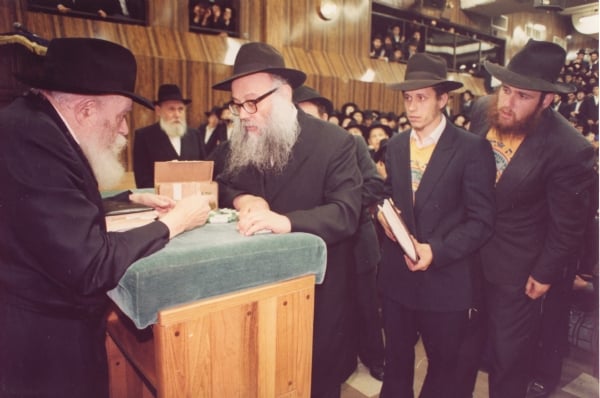
In the summers of 1990 and 1991 I had the great merit to be a head-counsellor in the flagship Gan Yisrael in upstate NY. The highlight of the camp was returning to Brooklyn with the entire camp and praying Mincha with the Rebbe. This was followed by the Rebbe giving an inspiring talk of about an hour and then handing us - the head counsellors – packets of dimes (10 cent coins) to distribute three to each child who attended the camp. One for Tzedakah, the other for themselves and the third was left up to the child to choose whether it would go to tzedakah or spent on themselves.

Receiving tzedakah from the Rebbe as a head-counselor in Camp Gan Yisrael

When I think back to that incredible experience and meditate on it I realize just how much emphasis the Rebbe put on Chinuch – EDUCATION.

And I recognize that however much Jewish educational opportunities there are, it’s not enough.

We need more and more Torah education for our children, and for ourselves, so that Judaism can thrive and grow.

Back to the beauty and importance of thanking Hashem after meals.

Here is the first paragraph of the Birchat Hamazon.

Blessed are You, L-rd our G-d, King of the universe, Who, in His goodness, provides sustenance for the entire world with grace, with kindness, and with mercy. He gives food to all flesh, for His kindness is everlasting. Through His great goodness to us continuously we do not lack [food], and may we never lack food, for the sake of His great Name. For He, benevolent G-d, provides nourishment and sustenance for all, does good to all, and prepares food for all His creatures whom He has created, as it is said: You open Your hand and satisfy the desire of every living thing. Blessed are You, L-rd, Who provides food for all.

A relatively short blessing. But so chockablock full of inspiration. 

Did you know that the author of this first paragraph of thanksgiving after food is Moshe Rabeinu?

What you may find even more breathtaking is that the food they were thanking G-d for, was the Heavenly Manna!!!!

It reminds us that while we may receive our bread in a more earthly way, through working and ‘hustling’, in reality it is really a gift from Hashem.

Let us become more grateful for the good that Hashem rains down upon us.

Especially, let us be more mindful of the greatest thing we can do in life.

Helping others!

Our Sages have told us we ought to cleave to Hashem by following in His ways, which is achieved by doing acts of benevolent kindness to others. Just as He does.

Appreciate your blessings more.

Give more to others.

May Hashem bless you with health, joy and nachas. As the Torah says, ‘if you bring joy to ‘mine’ (the unfortunates of society), I will bring joy to ‘yours’ (your loved ones).

As we are less than six weeks from Rosh Hashana let me get a headstart on that too.

SHANA TOVA,

Shabbat Shalom,

truth is the truth

As one gets older, I mean elderly to the point where they feel their days are numbered, they begin to think about leaving instructions for their loved ones.

They tend to be less cautious about giving criticism.

It actually is a very correct behavior. 

Moshe Rabeinu did this. 

As he was about to pass away, he gathered the Jewish people and spoke most of the book of Devarim – Deuteronomy. In the beginning of this week’s Parsha the tone of the speech includes a fair bit of constructive criticism.

At the end of the book of Bereshit the Torah relates how our ancestor Yaakov addressed his children before he passed away. The discussion was not only about the love and blessing he was transmitting to them. It also included some words of rebuke and reproach.

The Sages commented that there are various reasons for rebuking close to passing away. 

One of the most obvious reasons is the feeling that ‘if not now, when’?

Ironically, once the person has passed away, they can no longer speak. It is now his or her turn to be spoken about.

After a person passes away there are oftentimes speeches made in their memory. Eulogizing a departed person is very much about highlighting the special and praiseworthy attributes of the departed person. Not just because we want to honor their memory, but more importantly because we want to learn from them. We hope that the lessons they taught are inculcated by us and lead us to better behaviors. 

The things we talk about are meaningful. We don’t talk about how discerning a whiskey drinker they were, or how many Gucci handbags they owned. In highlighting the life of a person at a eulogy their kindness, commitment and piety is recalled. 

Talking about eulogies… I am reminded of a joke about eulogies.

A man once walked into the office of a rabbi who was quite well-known for delivering incredibly moving eulogies. Now, this man was, let’s say, exceptionally careful with his money. He wanted to plan ahead and save costs for his family, so he asked the rabbi, "Tell me, how much do you charge to speak at a funeral?"

The rabbi looked at him and explained that, like many things in the modern world, he had different options available. "We have the Platinum package. That is $10,000. Then we have the Gold package for $5,000, and our Standard package is $1,000."

The man, trying to calculate the value of every dollar, asked, "What do I get for the Platinum package?"

The rabbi replied, "Ah, for the Platinum package, I will pour my heart out. I will weep effusively, I will speak of your incredible deeds even if I need to stretch the reality a bit, and I guarantee you that by the time I am finished, there will not be a single dry eye in the entire synagogue."

"And for the Gold package?" the man asked.

"For the Gold," the rabbi said, "I will say very, very beautiful things about you. I will certainly shed tears myself, and a good portion of the congregation will be deeply moved to cry along with me."

The man thought about this. He thought about his wallet, and he wondered if he could push the limit even further. He looked at the rabbi and said, "Look, what if I only have $100 to spend? What do I get for $100?"

The rabbi smiled gently, looked him in the eye, and said, "Ah. For $100? For $100, I’ll just tell the truth."

Save your money.

The truth is the best.

Both in rebuke

And in eulogy.

Let’s learn from Moshe in this week’s parsha.

The following are the words that Moses spoke to all Israel on the east side of the Jordan River, regarding the sins they committed in the desert, in the plain, opposite the Sea of Reeds, in the Paran Desert, for having maligned the white manna, regarding the sins they committed at Chatzerot, and with their abundance of gold.

In each of these triggering mentions of places that they had sinned, there was also a subtly implanted defense and justification.

The one most obvious is reference to the ‘abundance of gold’.

This was a reference to the sin of the golden calf. It was really the worst of all sins, as it was an act of sheer idolatry a mere forty days after the greatest G-dly revelation of all times at Mount Sinai.

As bad as it was, Moshe was also presenting the context of why they fell into this horrendous mistake.

An abundance of gold. 

Moshe is hinting at the fact that drooling with gold and wealth is the backdrop that made them susceptible to sin.

It was not taking away their culpability for their bad choices. The Jewish people needed to ask G-d for forgiveness, and we are still wiping away the dirty smudges that obstinately seem to fade but not totally disappear.

Giving the context of having too much gold is taking away the sting and defiant betrayal that sinning conveys. Moshe is saying they were not intentionally rebellious, they simply fell into the trap of gold.

Rashi brings an example. If you put a young royal in a tempting situation with a purse full of gold coins around his neck, do you really expect him to withstand the advances and lures of the predatory sinners?

This is not a justification that whitewashes or allows the person to sin without conscience. If one is faced with forbidden temptation one needs to muster up every ounce of energy to fight and withstand it.

But Moshe was directing his reframing to the Almighty and offering a defense for the Jewish People. 

YOU, Almighty G-d, gave them the overabundance of gold. This created a great challenge. And alas your children have stumbled and feel regret. 

When you know the full truth, and all the circumstances, only then can you really know what the extent of the mistake was and what possibly caused the erring behavior. 

On the flip side. 

Overpraising someone when eulogizing them, especially embellishments that are not true, serve as no benefit to the soul. It is a great disservice.

Can you imagine the embarrassment one would feel if someone praised you for something you weren’t. Or gave you credit for something you didn’t do.

We need a balance as with everything in life.

When chastising or rebuking, (should be kept to a minimum and used sparingly) take the mitigating factors into account. Look at the whole picture, it may not be as negative as it seems.

And certainly, praise must be given. To those who are alive. And to those who have left us. 

To be proper, it must fit the reality not a wishful dream. 

I was thinking about this when hearing all the comments about the late Mrs. Myra – Esther bat Chaim Moshe – Borisute at her recent shloshim (30 day) memorial event.


Mrs. Myra was a remarkably powerful woman. Singlehandedly she raised six children in Bangkok when there was barely any organized Jewish life in the city and managed to get them all imbued with a true Jewish spirit which can be seen in her many observant grandchildren. Her enthusiasm for keeping kosher fueled her indefatigable cooking and baking sprees in her kosher kitchen which she shared with the community, for years being the de facto kosher bakery in town. Her determination and commitment to the mitzvah of family purity made her a fierce champion on behalf of the Mikvah that was built. Jewish afterlife care was so important to her that she worked tirelessly till we had a Jewish burial ground.

Listening to all the incredibly uplifting achievements made her sound so saintly.

Some of her family also painted her as a down-to-earth person with various challenges. Mentioning those challenges didn’t make her seem less noble. On the contrary, those handicaps could easily have torpedoed all of her remarkable achievements and notwithstanding that, she was a remarkable achiever in so many ways.

On a personal note, Mrs. Myra was one of those responsible for bringing Chabad to Thailand. Besides for her general financial support of the community there are some things that she gave us personally that really stood out. Her largesse and sensitivity got my wife a large American oven when it was almost unheard of in Bangkok. She gave me my first computer and printer as well as brought me into the world of mobile phones with a bulky Nokia when only the ‘bigshots’ carried personal phones (in her words ‘rabbi’s need to be reachable at all times..).

Mrs. Myra lives on through her children, grandchildren and a new great granddaughter born within a few days of her passing and named Esther for her. Her soul gets joy and nachas in the Jewish interactions and mitzvahs performed by the myriads of Jews who visit the chain of Chabad Houses and kosher infrastructure who owe thanks to her as one of Chabad’s earliest ‘investors’.

The truth is the truth. There is no need to shop around for a dressed-up eulogy. Once someone passes, they go to the world of truth. Only the truth ought to be told.

The following story will give you a way of thinking that you can copy paste to be used as a reframing tool when looking and judging others.

In a small Eastern European town, there lived a man named Berel. Berel was not a scholar, nor was he known for having refined manners. He was the town’s water-carrier, a physically grueling job that he did day in and day out. Over the years, the harsh winters and heavy yokes had taken a toll on him. He was known to have a very short fuse, a booming, gruff voice, and a sharp tongue that frequently flew off the handle when he felt slighted by the townspeople.

When Berel passed away, the town gathered for his funeral. The crowd stood in silence, wondering what the town Maggid (preacher) could possibly say about him. Everyone knew Berel's flaws; to paint him as a gentle, soft-spoken saint would be an obvious lie, an embarrassment to his soul in the Olam HaEmet—the World of Truth.

The Maggid walked up to the front, looked at the simple wooden casket, and began to speak the absolute truth:

"My friends, we all knew Berel. He was a man with a fiery temper. He yelled, he argued, and his words could be as biting as the winter frost. We cannot stand here and pretend he was a man of gentle speech."

A murmur went through the crowd. The Maggid was saying the plain, unvarnished truth. But then, the Maggid looked up toward heaven, his eyes filled with tears, and he shifted the perspective, providing the context:

"But Master of the Universe, let us look at why his shoulders were so tight and his temper so short. Every single morning, long before the sun rose, when the mud was thick or the ice was frozen solid, Berel was out there lifting heavy wooden buckets.

He didn't just carry water for those who could pay. He carried heavy buckets up the steepest hills to the homes of the poor, the sick, and the elderly widows of this town. He made sure they had water to drink and wash with before he took a single coin or a single sip for himself. His hands were covered in bleeding calluses, and his bones wrapped in constant pain.

You, Almighty God, gave him a life of crushing physical hardship. His gruffness was not out of rebellion or malice; it was the heavy sigh of a broken, exhausted body. Do not judge him by the sharp words he uttered when his feet slipped on the ice. Judge him by the freezing water he tirelessly carried for Your children with those very same calloused hands."

By the time the Maggid finished speaking, there wasn't a dry eye in the cemetery. He hadn't whitewashed Berel’s flaws; he had elevated them by revealing the reality of his struggle.

Hashem is True.

It is He who gives us our gifts. It is He who gives us our challenges. And it is He who truly knows what things are in our control and which are beyond.

As humans we need to be humble.

Even as successful, wildly successful, super-powerful and mighty as we may be, we can and ought to be humble. 

By one simple meditation.

‘Who gave me my success, my beauty, my money or my talent’?

The Almighty.

Did I live up to what I could have become?

Would someone else have done a better job utilizing my gifts?

Before you go to sleep take a moment to think about it.

And make the obvious resolution.

‘Let me try harder tomorrow’. 

As the code of Jewish Law says, ‘RISE LIKE A LION’ in the morning to do G-d’s will.

GOOD MORNING to you my fellow Lion. 

This morning you woke up. This means that G-d gave you back your soul. For a reason.

Go and make a difference in the world by studying Torah and doing Mitzvahs.

Lets bring Mashiach NOW, so that Tisha B’av (coming up this Wednesday sunset till Thursday evening) can be transformed from a fast day to a joyous feasting day.

Shabbat Shalom,

Rabbi Yosef Kantor


What am I needed for?

Have you ever found that when you finally arrive at a destination, it doesn’t seem quite as exciting as you imagined?

The anticipation and imagination of what it would be like at that yearned-for endpoint is often much more enjoyable as a vicarious goal than the actual reality on the ground.

It starts when we are children. Summer vacation is something we look forward to all year, eagerly counting down the days until the end of school. Yet, once the holidays actually start, children quickly begin complaining and whining about being bored. At some stage of the long break, many kids secretly look forward to resuming school (albeit they won't admit it when asked).

Is it any different with adults?

How often does someone pursue a goal—whether it’s wealth, influence, or a specific status—believing it will bring them happiness and personal fulfillment, only to discover that the reality requires a level of responsibility, commitment, and consistency they didn't bargain for?

I have watched people rise to financial wealth and then start to feel insecure, overburdened, and self-conscious—almost regretting their newfound success. As an elusive goal, money seems to be a ticket to happiness. So does fame. If you are an "influencer" trying to gain subscribers and followers on social media, you imagine that when you hit your goal of reaching millions of fans, you will be the happiest person around.

Yet, it doesn’t seem to be that way. Too many famous people are downright miserable.

This week, I was counseling one of my young Jewish friends who recently lost a friend of his. His friend was a well-known influencer who achieved fame and money before the age of thirty, but died prematurely due to a freak accident. Because of my indirect connection, I picked up on some posts this celebrity influencer had made not long ago. They indicated clearly that being incredibly popular and sought-after had not made his life happier or easier; rather, it made his life more challenging and filled with anxiety.

He deeply questioned his success. Did people really follow him because of who he was, or merely because he was a good actor?

This really jolted me. This was a person who regularly posted about topics he considered beneficial to his viewers. He wasn’t questioning whether he had provided value; he was disturbed and unnerved by the fact that he was not being "true" to his inner self.

And I ask: So what?

Is the most important thing in life to be who I think I should be, or to do what the Creator created me for?

I am fully aware that today’s society considers one of the most compelling missions of life to be reaching self-actualization, filled with a sense of meaning and purpose that spells happiness. In and of itself, it is noble to try to fulfill your potential. And generally, these two tracks are meant to be one and the same. G-d gives you talents and abilities and puts you in scenarios that all point to the mission He chose for you.

In a more general sense, when a Jew keeps Torah and Mitzvahs, it is the surest expression of self-actualization. It is the only recipe to achieve true, authentic, and deep happiness. G-d created us and gave us the "manufacturer's guide" to self-fulfillment, which is oneness with G-d.

Yet for some people, once they develop their potential, they start to feel an unease. This can lead to "losing the plot." It may even feel spiritually compelling to step out of G-d’s plans and seek an alternative spiritual destination.

This week’s Torah Parsha spells it out. Let me explain what I mean.

This week’s parsha refers back to the mistake and sin of the spies. They rejected going into Israel. Why? They had waited 210 years through exile and torture in Egypt to finally come out and be led to the Promised Land—a land flowing with milk and honey. Why did they reject it?

Because they sent spies to scout the land and bring back a report. In a sense, they got a glimpse—almost like a virtual reality look—at what living in the anticipated destination of Israel would actually look and feel like. And they didn’t like what they saw one bit.

The desert was spiritual bliss. They were surrounded by clouds of glory and ate manna from heaven. Entering Israel, however, meant they would have to work the land and live a fulfilling but mundane life.

"Not for us," said the spies. Most of the people agreed with them, preferring to stay in the desert.

We all know how that turned out. Hashem and Moshe were far from happy (to put it mildly) about the choice the Jews were making to avoid Israel. Where did they go wrong? They didn’t realize that the truest and deepest connection to the Divine would come through getting their hands dirty by tilling and working the soil. Hashem desired that the mitzvahs be fulfilled in a physical way, which could only be realized by entering the physical Land of Israel.

I am reminded of a similar scenario that happened with the Rebbe. It was during the large Purim celebration in 1955. The Rebbe asked who would want to be blessed with the gift of wealth. Out of the many hundreds in attendance, only a few people raised their hands.

Why didn’t more raise their hands?

Because although wealth is usually viewed as "rosy" and desirable, the Rebbe had first spoken at length about the immense responsibility and challenge of being wealthy. This shifted the mindset of the crowd from viewing money naturally—as a key to an easier, happier life—to viewing it as a powerful, demanding mission that carries psychological and spiritual challenges.

The Rebbe had described this reality with such vivid color that, in a sense, he had taken them on a "virtual journey" into the demands wealth places upon a person. In response, the crowd maturely demurred, hesitant to take upon themselves this harder path.

But the Rebbe was disappointed. Because that hesitation missed the point of what life is all about: to do what Hashem wants of us. Hashem wants us to use the wherewithal of money to be His treasurers here on earth—to perform acts of kindness, charity, and goodness. Even if it’s a more challenging path.

Let me tell you a story:

A Chassid once came to the Alter Rebbe with a list of personal struggles and needs, asking for a blessing. The Alter Rebbe looked at him and said: "You are highly concerned with what you need from the Almighty. But you haven't asked: What does the Almighty need from you?"

This single sentence, with all of its depth, penetrated the Chassid’s mind and heart so deeply that he fainted on the spot. It speaks perfectly to the tension that can sometimes exist between personal desire and divine mission.

Like in the case of the spies who preferred the spiritual sanctuary of the desert, where manna fell from heaven and their material needs were miraculously met. They feared that entering the Land of Israel meant losing their spiritual focus to grueling, physical labor. However, the Almighty wanted them to go and live a physical life in Israel.

Chassidic thought teaches that their sin was a bit more subtle than it seems. It was the mistake of choosing their own version of spiritual fulfillment over what G-d actually expected of them—which, of course, would have led them to an even deeper spiritual fulfillment than they could have foreseen.

The Rebbe was disappointed when the Chassidim didn’t opt-in to the blessing of wealth for the exact same reason. The Rebbe reminded us that wealth is a mission-oriented gift, given specifically to expand and enhance what one can do for G-d by helping others, even though it comes with immense challenges.

The same applies to influencers, or to people gifted in any of the multiple ways G-d bestows His blessings.

When we achieve success and then face unanticipated hardships at our destination, conventional wisdom tells us to ask, "Is this making me feel fulfilled? Am I self-actualizing to my greatest capacity?"

Torah wisdom teaches us that the question should not be "What am I getting out of this?" but rather, "What am I needed for? How do I serve G-d through this specific reality?"

I have found this question to be present among many people these days. I find it especially pronounced as people proceed into the more advanced decades of their productive lives (kind of ‘midlife crisis?), once major goals have already been achieved. A person "knows" they should be happy, but somehow, that anticipated happiness isn't there.

What should we do?

Sometimes a big change is needed. 

But often life just needs reframing. 

Ask not what makes me happy; rather, ask, "What am I needed for? What does G-d want of me?"

How do you know which is true in your case?

This is precisely why the instruction in Pirkei Avot, "Aseh lecha rav" ("Make for yourself a rabbi/mentor"), is indispensable. A mentor who holds the values of Torah-based morality provides an objective mirror. They help you look past the external illusions of success or the heavy fatigue of responsibility, guiding you back to your ultimate purpose. A mentor can help you look at yourself objectively so that you don’t run away from the responsibilities and gifts that G-d has entrusted to you.

If you are feeling a little disenchanted with what you are doing in life, before making a drastic U-turn, try this piece of Torah wisdom: Do a spiritual "checkup." Take counsel with a wise person who can guide you.

May we all be blessed with the ability to know and commit to G-d’s Divine plan for each and every one of us. This will reach its blissful peak with the coming of Mashiach, NOW.

AMEN.

Shabbat Shalom,

Rabbi Yosef Kantor

they are warmly welcome too

I’ve always wondered.

How do kids know that they can get away with misbehaving, that their parents won’t kick them out of the house?

In their friend’s home they act properly.

At school they maintain the decorum.

Why do they feel comfortable to be disrespectful at home?

Because they know their parents will tolerate them even if they don’t ‘toe the line’.

How do they know?

Same questions go to spouses. 

A man who would never ignore a colleague at work may remain engrossed in his hobby at home and not respond to his wife.

Or vice versa a woman who never raises her voice in the public arena may scream at the top of her lungs at home.

Why do people act differently with their own family than they do with outsiders?

It all boils down to the same point.

We have an inner compass that allows us to judge what kind of behavior will be tolerated in each differing environment.

That inner discerning voice tells the little child that if he acts out at my friend’s home, he won’t be invited back to a play date with his friend. 

Forward thinking and good planning for a child means that if I had a good time at my friend’s home and want to be allowed back for a play date, I had better tidy up the mess I made.

That same innate judgment assures the child that if he doesn’t clean up his mess at home, he won’t be kicked out of the house.

It’s the way it is meant to be.

Love, real love, needs to be far deeper than a transactional relationship.

And today we know more than ever that it is critical that our children don’t mistakenly think that if they are not perfect they will be ejected from home. 

In an ironic twist, in today’s day and age, many children subconsciously misbehave and act in a way they know is not causing nachas and pride to their parents because they crave the validation and knowledge that their parents love them even if they are imperfect.

Here in Thailand, we meet our fair share of young people who are testing the boundaries of their parent’s love. Rather than see them as rebellious, we ought to view them from the lens of understanding what they are truly intending, albeit subconsciously. By behaving differently than the expectations of their parents and of their close-knit religious communities they are digging deep to see if the love of their parents extends to them beyond boundaries. 

The parents of today have re-learned parenting and are starting to see this misbehavior as not being an act of defiant rebelliousness stemming from hatred. Rather there are issues related to childhood trauma, insecurities, phobias and a whole plethora of possible root causes that express itself in the behaviors and attitudes that challenge the parent child relationship. 

Often, by the parents digging deeply into their soul and igniting a love for their child, the relationship can be saved. It can even be rekindled and fanned to grow to a more passionate than average relationship with the child that was the most challenging. 

This topic is a very profound one and I have oversimplified but I trust that you hear my point.

It is not easy to actually live with this kind of love and it takes getting used to as it seems to run against traditional thinking and is certainly not instinctive. It needs to be learned and worked on.

It seems to be working.

From my observation and engagements with many differing styles of Jewish communities from all over the world (believe it or not Bangkok seems to be at the epicenter of many Jewish communities. A topic for an article in itself)  this way of thinking and behaving is currently yielding very powerful results in healing many fractured and compromised relationships. 

Which is why I found it intriguing and fascinating to read in this week’s parsha about Hashem’s instruction to Moshe regarding his appointment of Joshua as the successor of Moshe. 

Bamidbar 27:19  And you shall present him (Joshua) before Eleazar the priest and before the entire congregation, and command him in their presence to tolerate their stubbornness.

Rashi comments: And command him - about the Israelites: Know that they are troublesome and they are stubborn. You are given this position on condition that you accept this burden upon yourself.

I can understand that a Jewish leader needs to be reminded that the people may be stubborn and that part of his job is to accept them even with all their difficulties. 

But why does Hashem insist that this tolerance clause be done in the presence of the people?

Shouldn’t this be told in private to the leader that he should be ready for the challenges of disobedience? 

Wouldn’t it be more effective if the people would be instructed to be obedient without knowing that Hashem has already put it a clause that keeps them under the leadership of Joshua even if they misbehave?

The way Hashem instructed Moshe to transfer the leadership seems to almost be an invitation to the people to test the limits of their relationship with their leader.

Wouldn’t it best be done in a private conversation with the leader?

(see Ramban - Nachamides on this verse who raises these concerns and therefore offers a different meaning to the verse).

To me, it seems clear that Hashem wants both the leader and the community he is leading to know that their bond is consummate and unshakeable. 

That every single Jew hear the message that the connection of the Jew to Hashem and to Hashems servant Moshe (and all subsequent Jewish leaders) is unshakeable. Even when there is stubborn disobedience the bond is intact. It may be causing irritation and pain but the Jew is not severed from his ‘head’ the leader of the generation. 

This means that a Jewish leader needs to know that he is not just leading the righteous and obedient members of our people. The leaders need to be dedicated just as much (and perhaps even more) to the challenging children. 

And Hashem wants us to know from the outset that even if we are difficult, we cannot ever break our connection with Hashem and with Moshe His servant. 

The result will be that the children, the Jewish people will be more deeply connected to Hashem.

Just like a child loves his mother more than his friend’s mother. Even though he doesn’t clean up his toys when his mother asks while he does tidy up for his friends’ mother. Externally it may seem that his love for his parent is mitigated and limited. The reverse is true.

It is similar and even more existentially true when it comes to the relationship that every single Jew has with Hashem.

As I was dwelling on this message – which I only discovered this year after many decades of reading the weekly Parsha - I realized how Hashem was sending me a timely message that is so relevant to me  this very week in 2026 in Thailand.

The Bangkok Post chose to run the following article yesterday about a person who opened a ‘Bayit Chiloni’ – a ‘secular house’:

A group of secular Israelis has opened a community center on Koh Phangan, saying it wants to offer Israeli visitors to the tourist island an alternative to the “indoctrination” found at Chabad houses.

….

It has been set up directly opposite the local Chabad House on Koh Phangan….opposes the Chabad movement and the concept of Chabad houses abroad, Naor Narkis, a secular Zionist activist and politician, told the Jerusalem Post…. 

Chabad houses are informal Jewish community and outreach centres operated by the Chabad-Lubavitch movement. They function as a “home away from home” for Jewish travelers, students and residents, offering religious services, classes, counselling and communal meals.

There are six Chabad houses in Thailand: in Bangkok, Chiang Mai, Phuket, Koh Samui, Koh Phangan and Pai.

“Religious organizations are present everywhere Israelis are found; their strategy is transparent and clear — and I’m so happy that a secular foothold is now being planted thousands of kilometers away from Israel in order to strengthen secular identity,” Mr Narkis said.

It is so preposterous that it is hilarious. 

To call a Jew a ‘secular’ Jew is blending two different kind of descriptives that don’t use the same currency.

‘Jew’ is a religious term. Secular is a description of how you behave. You are either Jewish by G-d’s definition (born to a Jewish mother, or converted according to Halacha) or you are not Jewish. 

Some Jews don’t express their holiness and G-dliness as much as their potential allows. Some Jews try harder to express their inner core self as a Jew. 

Tzvi Freeman puts it like this:

In modern-day jargon, the term "Orthodox" has come to designate those of us who don't change  Torah just so it should fit in better with what everyone else is doing. In that sense, I definitely count myself among the "orthodox." But I sure don't feel orthodox. Should I?

That's another thing the  Lubavitcher Rebbe said: "Labels are for shirts." Okay, there are other things that can take labels. Like Reform Temples, Conservative Synagogues. But the Jews that you'll find in these places have all just one label: Jews. Because "Jew" is not a behavioral term. It's an essential state of being. It's not where you're at, it's where you belong.

So if anyone should ask you to describe the three kinds of Jews today, answer as follows:

There are three types of Jews:

  1. Jews who do mitzvahs.

  2. Jews who do more  mitzvahs.

  3. Jews who do even more mitzvahs.

And that's about it, because a Jew can hardly breathe without doing a mitzvah.

Click here for full article

Of all weeks to meet up with such a ridiculous press conference, Hashem sent me a message tin the Torah Parshah to guide me on how to react.

With LOVE.

Some 3300 years ago, Hashem has already preinformed us about the stubbornness of some of our people. 

Yet, the Jewish leaders in an unbroken chain from Moshe, Joshua, till the Rebbe in our generation, have been instructed to be the head and leader of these ‘wayward’, ‘stubborn’ and ‘misguided’ fellow Jews as well at the more devout ones.

This is why the Chabad House in Koh Pangan, like every Chabad House in the world, founded by the Rebbe to be a home of unconditional love for every Jew, is not getting offended and is not putting up barriers. Rather we are warmly welcoming all Jewish including those activists of the so called ‘secular house’ to uncover their true identity and join for Shabbat, to pray, eat, study and congregate together with love and inclusivity.


Chanukah Candle lighting at Chabad Koh Phangan

My friends and colleagues around the world have reached out to me wondering how this is impacting our work.

I responded that this group has done us a great service.

The outpouring of support for the Chabad House in Ko Pangan is incredible. Someone even called to donate funds to expand our school there. So that we can have room for more students in our ‘waiting-list-only’ Chabad preschool in the island.  

Graduation last week at Chabad Koh Phangan's preschool.

This is the Rebbe’s version of responding to darkeness. Adding more light.

But in terms of anti-israel and anti-Jewish sentiment, this ‘secular’ activist has harmed the Israeli community living in Thailand at a time when we are already so vulnerable. 

A local veteran journalist asked me ‘why did the Bangkok Post share this story, it is not newsworthy in an international sense’?” 

I think it is obvious. It delights our enemies. It portrays us as confused people. The bad press about Israel’s and Jews is fed by such eccentric shenanigans about people who can’t even seem to get along with each other

However much we inside the Jewish community know that it is silly and bizarre to open up a ‘secular house’ (there are plenty of unholy venues in Thailand already, I don’t think you need a rabbi to tell you that…), our enemies have a field day with this kind of article. 

Let me be very clear.

As misguided as they are, they are our Jewish brothers and sisters who are waiting for their souls to proclaim with pride 

SHMA YISRAEL AD text-decoration: revert; color: rgb(102, 102, 102); line-height: 30px; background-color: rgb(255, 255, 255);open sans", "helvetica neue", helvetica, arial, sans-serif !important;">This week’s Parsha proclaims loud and clear that G-d loves each and every Jew so much that He makes it compulsory on the leader to let the troubled rebellious Jew know that he or she will always be loved and cared for by the leader.

During these ‘Three Weeks’ as we remember the destruction of the temple in Jerusalem nearly two thousand years ago, which was facilitated and caused by our inner baseless hatred for each other, we need to bring about the redemption by acts of pure unearned love for each other – Ahavat Yisrael with no boundaries.

May we merit to love each other, to love G-d and to love His Torah and welcome the Mashiach NOW. AMEN

Shabbat Shalom,

Rabbi Yosef Kantor

DO and LIVE with pride in your Judaism

There is a classic folklore joke.

There was once a farmer. He looks at his horse, and he thinks to himself, "Oy, this horse... it eats so much hay! It costs so much money! Why does a horse need to eat so much? What if, bit by bit, I teach this horse to make do with less?"

So, he comes up with a plan. A very logical plan, according to his own mind. He says, "Today, I’ll take away just one piece of straw. The horse won't even notice."

The next day? Another piece of straw.

The horse keeps pulling the wagon. It’s a little slower, it looks a bit tired, but the farmer thinks, "Aha! Look at this! It’s working! We are making progress!"

Day after day, less food, less energy. Until finally, the big day arrives. The farmer is so proud. He goes to the barn, and he gives the horse absolutely nothing.

The next morning, he walks into the barn, ready to celebrate his great success. And what does he see? The poor horse is lying there, completely still. Dead on the floor.

The farmer throws his hands up in the air and sighs from the bottom of his heart: "Oy vey! What a tragedy! Just as I finally taught him how to live on nothing, just when he finally learned the trick... he goes and dies on me!"

It’s a silly joke.

But it’s not a laughing matter when one observes how flippantly some people treat the nourishing that they give their souls.

No Jew that I know, intentionally wants to weaken their Jewish identity to the point of mortal danger. 

Many, figure that they can take away this observance, that observance and still keep the ‘Jewish Identity’ alive.

The farmer didn't try to starve the horse all at once. He took away just one piece of straw.

Declining Jewish observance works exactly the same way. Rarely does someone totally drop their Jewish observances cold turkey.

Instead, the inner negative voice whispers, "You're so busy today. Just skip this mitzvah you usually do." or "You can skip your daily schedule of daily Torah learning just this once, you will still be a good Jew." 

When a person starts diminishing their Jewish observance bit by bit, they often feel completely fine at first. They think, "Look, I skipped this holiday, or I was a little more lenient on my standard of kosher, and I still feel connected, I’m still a good Jew!" 

But what they don't realize is that their identity may be running on leftover reserves. The momentum of past observance is keeping them moving, but no new fuel is being put into the engine.

Spiritual decline often looks gradual until it suddenly looks absolute. 

A person might wonder, "How did someone fall so much from the traditions of their youth?" The answer is almost never that they changed overnight. It’s that they were cutting back a single piece of straw every day for years, and eventually, the soul simply had nothing left to sustain its warmth.

If the formula works for the negative, it works even more powerfully for the positive.

It is of supreme importance to feed your soul often. You don’t need to become a perfect tzaddik overnight. Just do something. Even if it’s small.

Just like the soul can be starved bit by bit, it is built up bit by bit.

Adding just one Mitzvah, reading just one text of Torah a day might seem as insignificant as a single piece of straw. But that daily spiritual nutrition is exactly what keeps the Neshama (the soul) alive, vibrant, and strong enough to pull any wagon life throws at us.

Especially if we are talking about transmitting Judaism to the future generations.

You know as I do, that it is extremely unrealistic to expect your children to keep to your ‘red lines’ if you have not given them robust, and joyous Jewish experiences.

Where is the point of danger?

If one wants to be painfully honest, it is the first piece of straw that you withheld from the horse that led to its demise.

When it comes to Jewish continuity, that seemingly small inconsequential compromise can be the slippery slope that leads to total neglect.

On the flip side. That one mitzvah you do, can be the ‘entryway mitzvah’ to catapulting you deeper and higher into your Jewish experience. 

In today’s Parsha the prophet Balaam tries to curse the Jews and it turns into a blessing.

From Aram does Balak the king of Moab bring me
From the mountains of the east, saying:
Come, curse me Jacob
And come, provoke wrath upon Israel

How shall I curse, whom G-d has not cursed?
How shall I evoke wrath, against whom G-d has not raged?

For from the top of mountains I see him
from the hills I behold him
It is a people that dwells alone
And is not reckoned among the nations.

Today more than ever, see how we are people who ‘dwells alone’.

There is no other nation that is singled out for hatred and bigotry, now and for thousands of years, as the nation of Israel.

Even here in Thailand. 

I used to say proudly that there is no antisemitism because people don’t even know what Jews are.

No longer.

They now know who we are. 

And while thank G-d the Thai people are overwhelmingly kindly, our enemies (assumedly sponsored by the usual sponsors of antisemitism worldwide) have launched an ongoing campaign in Thai media to sow seeds of Jewish/Israeli conspiracy and colonialism. 

In a meeting with a Thai service provider this week, he innocently asked me why do ‘your people think that Ko Samui is the promised land’. When I told him there's no such thing, we have one promised land and it’s not in Thailand. It’s in the middle east and it's called Israel, he said ‘but I heard in the news that your people want to colonize Ko Samui as part of your promised land’….

Bizarre and preposterous as it may sound, the drip marketing of our enemies is having an effect. 

Even if we had the copious amounts of money to do a counter campaign to present our people in a positive light, I am not sure that it would spread as well as the negative campaign. 

What the outside world thinks about us and how it treats us is not up to us.

How we view ourselves, the attachment we feel to Judaism, this IS up to us.

This is something we can take steps to rectify.

It is tragic to me is when I see that some Jews only get the enmity that comes from our haters for being Jewish and don’t engage, celebrate and relish the specialty of being Hashems special people.

Who wants to be part of an ‘oy vey’ culture. We need to keep our Judaism joyously uplifting and inspirational. 

If you want your children to be proud Jews you must DO Jewish things, and LIVE with pride in your Judaism. 

When we try to hide, it doesn’t work. When we try to be ‘one of them’ they uncover our farce and get even more upset at our attempts to deceive them.

When it comes to Jewish education, sending to a Jewish day school is top tier.

Sending to a Jewish overnight camp is great as well.

Jewish day camp is a wonderful way to bolster your child’s Jewish identity.

For more information about the incredible day camp that my wife Nechama runs in Bangkok for Jewish children click here. (In today’s climate, security is a paramount concern, and we invest heavily in providing a secure setting).

Even if you are jittery about publicly celebrating your Judaism, the mitzvahs of the Torah are able to be kept at home. Lay tefillin. Light Shabbat candles. Make Kiddush and eat a family Shabbat dinner. Study Torah. All in the safe and secure privacy of your home. Instill Judaism into your ‘veins’ and ‘bloodstream’.

If you have the courage to wear your Judaism proudly, do it. It’s not just good for you, it helps others as well. Compounded benefit.

Someone recently told me that when they see Jewish people walking around with kippa’s identifiably Jewish, they feel strengthened and bolstered, even though they are too scared to do so.

A Jew who I put on tefillin with for the first time in his life at age 89 shared with me that he felt comfortable agreeing to put on tefillin with me as he had seen Jews wearing tefillin on planes and in airports. 

You never know the extent of the ripple impact you have when you embrace and celebrate your Jewishness.

Ultimately, we should not back down or be dispirited. We the Jewish people must double down on our efforts to build a strong Jewish identity within ourselves, our families and our communities.

We should be careful not to replace authentic Jewish experience with a synthetic manmade one.

The only enduring and authentic Jewish identity is Torah and Mitzvahs that are given to us by G-d at Mt. Sinai through Moshe and the subsequent Prophets and then the Sages of the Talmud. 

All other variations and adaptations come and go. 

Only adherence to Hashems and His instructions to us, provide us with the ‘Am Yisrael Chai’ eternity. 

On this Shabbat we also celebrate the 12th Tammuz.

99 years ago, late at night, on June 14th, 1927, the Sixth Rebbe—Rabbi Yosef Yitzchak Schneerson, of righteous memory—was arrested by the Soviet Secret police and taken to prison. As shocking as it was, it was hardly a surprise. As the acknowledged leader of the Jews in the Soviet Union and beyond, he was a fearless advocate for upholding Jewish traditions and the freedom for Jews to live and worship in accordance with the Torah—a thorn in the side of Stalin's ruthless march toward the Marxist utopia.

As word spread, Jews all over flocked to synagogues to pray, and activists from Latvia to the United States began advocating on his behalf.

The Rebbe's death sentence was commuted in favor of 10 years of hard labor, which was then further reduced to exile. The Rebbe was swiftly transported to far-off Kostroma, where he was to remain, isolated and under close surveillance, for 3 years.

Then, less than two weeks later, on the 12th day of the month of Tammuz—which was also his 47th Hebrew birthday, he was given the news that he was free to return home and resume his holy work.

The miracle of his release is celebrated annually by Chassidim as a "day of liberation" with Chassidic gatherings, inspiration, and joy.

It is ever more relevant today, as we face an onslaught of enemies who wish to sow fear and dread within us.

Standing undaunted and defiant in our connection to Hashem and in observance of His mitzvahs requires determination and stoic commitment.

In certain circumstances it even requires putting our lives on the line literally. 

In our times for the most part it means that we need to remain steadfast in our commitment to Hashem. Indifferent if the face of the cynical voices, immune to the heretical social media posts and withstand any impure desire we may have to blend into the non-religious contemporary scene.

We are gifted by G-d to bear His Holy Name.

A nation who dwells alone. As the people of G-d who is One and Only.

Let us dance and celebrate this singularly blissful blessed life He gives us.

And pray for Mashiach to come NOW.

Rabbi Yosef Kantor

32 years, celebrating heart and love

A photo popped into my computer from ‘this day five years ago’.


It was the wedding of Benyamin, son of our very own Zevulun, the ‘Jewish rice farmer’ from rural Thailand.

Zevulun discovered his Jewish identity in his fifties when he still only known by his given name of Scott. Click here for Zevulun’s story in his own words.

Another picture jumped up from this date two years ago from the 2024 Gala in New York marking three decades of Chabad of Thailand.

At that event we showed a video of Danny Namatinia whom I had the merit to teach for his bar mitzvah, sharing his memories as he stood proud, brave and heroic as a soldier in the IDF.


Yesterday I had the great privilege of meeting up with Bangkok born and bred Paul Keen (a former bar mitzvah student of mine) at the Rebbe’s Ohel for Torah study and prayer.


All these memories point at one phenomenon.

Am Yisrael are one. 

The deep, existential, inextinguishable spark in every Jew is merely waiting to be revealed.

Some of the ‘flock’ wanders far away.

The leadership of Moshe was defined as a ‘faithful shepherd’ of Israel.

And it has remained the same throughout Jewish history.

The job of the Moshe in every generation is to shepherd the sheep, every single one of them, and ensure that they have their needed pasture. 

In our times it is so crystal clear and obvious how the Rebbe’s leadership is about lovingly and faithfully shepherding the Jewish people. 

And a nurturing of their inner faith and connection to G-d.

To every Jew across the globe. 

Regardless of one’s prior knowledge. 

Irrespective of one’s level of observance. 

Transcending the external dissimilarities in dress, language, behavior or anything else.

I am in New York in honor of the 32nd anniversary of passing – Yartzeit Hilula – of the Rebbe.

In Hebrew, words have numerical value, and Lev equals 32.

As we approach the Rebbe’s 32nd Yahrtzeit tomorrow (Thursday Tammuz 3, June 18), the theme is heart and love. 

A Rebbe is the heart of his people. As the lifeblood of even the body’s farthest reaches flows from the heart, the vast, diverse Jewish community finds unity in a real Rebbe. 

Like the Kohen Gadol, about whom the Torah declares that he bears the names of the Tribes of Israel upon his heart, the Rebbe carries his people on his heart.

A Rebbe agonizes over the suffering of any of his people and is ecstatic over their good fortune, the way the pulse reacts to the trauma or pleasure of any part of the body. 

A Rebbe cannot feel aloof or indifferent. 

The human heart is vital because it is the body’s great unifier. Without that service, it loses its very vitality. 

A Rebbe’s love for his people is like the heart’s devotion to the body. 

It’s that natural, and that unconditional. 

On this day, it’s a special time to reflect and ‘take to heart’ the ideals and values and legacy of the Rebbe.

To follow the lead of the Rebbe. 

To not be satisfied with being a passive bystander. Rather, adopt that feeling of responsibility for everyone that the Rebbe exemplifies.

And do so with love.

The Rebbe is all about love for the Jewish People.

This is evident in the loving mission statement of the Rebbe’s ‘houses’ – the Chabad Houses everywhere.

It is about looking at one’s fellow with a kindly eye and joyous attitude. 

It is an acceptance of people where they are, and the desire to help and to teach and to inspire. 

The health of the heart is the health of the body, and the health of the body is the health of the heart.

One separates them at his own peril. 

Our Sages taught: Moses is Israel and Israel is Moses. 

The Rebbe is the people, and the people are their Rebbe.

At the Rebbe’s 32nd Yartzeit, the year of the heart, these words ring in our ears. The Rebbe served - and continues to serve from On High - as the heart of our people. 

Through the Rebbe’s nurture and education, as this world becomes smaller and smaller, we recognize more and more that every one of us must be there for everyone of us. 

We’re all vital. 

We’re all nerve centers and powerful unifiers.

We have it in us, and the Rebbe encouraged it: you be the heart. 

Let’s be all heart, one soul, a people undivided - just as we were, and continue to be, in the eyes of our dear, saintly Rebbe.

Do a mitzvah today.

Reach out lovingly to a fellow to help them physically and to help them spiritually by teaching them to do a mitzvah, by studying Torah with them.

Together, we will pray and believe and hope that we succeed in the most urgently singular mission that we need to rally around right now.

It will eradicate antisemitism as well as any form of bigotry and hatred, war, illness and suffering in one fell swoop.

Goodness and positivity will reign supreme.

The Rebbe told us that Mashiach is about to come.

Then we will be reunited with all our saintly leaders and all our loved ones as the curtains are opened on the revelation of G-d’s presence here in this world.

Amen. 

Shabbat Shalom,

Rabbi Yosef Kantor

PS. I am writing earlier than usual to give an opportunity to send me your names for prayer at the Rebbe’s Ohel on the most auspicious day of his Yahrtzeit/Hilula.

a reminder - miracle story

Here is another AI vs human intelligence contrast.

I started to write an article and although it was starting to take form and develop into a nice article, time constraints are not going to allow me to finish it.

AI wouldn’t have let me down, it would have ‘produced something’.

I am human. 

This week my efforts did not bear fruit in the timeframe I intended.


So, I turned to my Shabbat Shalom from Bangkok archives to find an article that would be appropriate to share.

I found this miracle story I shared fifteen years ago and really connected to the lesson.


Enjoy the below.

Shabbat Shalom
Rabbi Yosef Kantor


Dear Friend,

For the bad news that goes on in this world, you don’t need me to point it out. Just go to any news service and unfortunately you will be pelted   by an avalanche of not very exciting pieces of information. But when it comes to the GOOD news, this is where I feel I have a ‘niche’ to ‘harp on it’, to highlight it (with a figurative bright yellow neon marker) and bring it to the forefront of our awareness.

Less than one month ago on a Monday morning as I was driving through the traffic filled streets of Bangkok an urgent call came through to my phone. It was not anything that concerned me or my immediate family, but it was something that affected me as a member of the Jewish people. ‘There is an El AL plane that has problems in its landing gear and is dumping its fuel as it prepares for a  landing without functioning landing gear’. The person who called me ended with one short word, Rabbi, Pray! This was the reaction of tens if not hundreds of thousands of Jews around the world who all began doing the only thing they could do to help a planeful of people circling over the Mediterranean. A short while later emails and sms messages starting arriving informing of the most welcome news that the 777 Jet landed safely. Of course in my mind it was a miracle. Yet, it was difficult to announce conclusively that it was a miracle as there was some suspicion that perhaps the landing gear was never faulty rather the signal that alerted the pilots may have been lighted up in error, caused by a short circuit or something similar. In other words, maybe the scare was misplaced.

Below I bring you quotes from one of the main Israeli news sites that clarifies in ‘black on white’ what a miracle we were blessed to receive three weeks ago.

May 26, 2011 – Ynet (Hebrew News from the Israeli Newspaper Yideot Achronot) The headline reads, “Fracture in -777: Boeing engineers had never seen such a thing.” The article continues, “Aviation accident investigators from Boeing in Seattle and from Israel’s Ministry of Transport dismantled the Boeing aircraft landing gear of the plane that carried out an emergency landing earlier this week and were surprised to find a big break in it. ‘It was a great miracle,’ said a senior source in the aviation industry. Boeing engineers were stunned. They had never seen anything like this . . . ‘The plane was hanging by a thread, and it is clear to everyone that this is a big miracle,’ explained a senior aviation official. ‘Technically, the landing gear was destroyed.’ . . . Boeing engineers were no less amazed.”

One of the most important attributes that one needs to inculcate into ones personality is the concept of ‘hakarat hatov’ which means recognizing, acknowledging and thanking someone who has been kind to you. In the reverse, there is nothing as disturbing as an ingrate. It is therefore my distinct pleasure and I actually consider it one of the most enjoyable parts of my job to point out the happy, good and openly miraculous things that G-d provides for us in this world. Take a moment and think about it. Miracles happened back then, they are happening right now and G-d willing they will continue to ‘appear’ whenever needed.

I would like to use this forum to say a public ‘thank You to G-d’ for his great miracle. I cannot and do not even want to think of what could have happened in the absence of the miracle... Thank You Hashem for the great gift of life.

In summation:  Say a prayer for a loved one who may be in a situation that seems hopeless. G-d will definitely listen and He may just grant you that miracle that you are praying for.

Shabbat Shalom,
Rabbi Yosef Kantor


How long is too long.

By the Grace of G-d

Dear Friend,

How long is too long.

In reverse, how short is too short.

It really depends on the situation. 

And it depends on who you ask.

A child will tell you that school holidays are too short.

The parents may argue that school holidays are too long.

On the eve of Pesach after the Seder, some sing the ‘who knows one’ song. 

One is Hashem in the heaven and the earth… it continues number by number till it reaches nine. Who knows nine? Nine are the months of a baby’s birth.

This number is embedded into nature by G-d Almighty.

For some aspects of life, we see clearly that it is G-d who determines the pace of life.

Other things seem much more dependent on human intervention and they are constantly changing. 

Like travel speeds for example.

How far can a person move in one day?

Up to one hundred and fifty years ago approximately the furthest a person could travel in one day was the speed of his horses.

Once we had automobiles that changed. 

Airplanes changed the dynamic even more.

For decades now we have been ‘stuck’ at subsonic speeds. 

Flying from New York to Thailand took around 17 hours when there was a nonstop flight.

Hypersonic planes are not yet feasible but if the challenges are overcome, one would be able to have breakfast in Bangkok and lunch in New York before even getting hungry.

It’s simultaneously thrilling and unnerving when I think about it.

Let me home in on the topic of speed of travel for a moment as its related to our weekly Parsha of Beha’alotecha.

This week we read about the continuation of the journey that the Jews took through the desert.

Initially Hashem had the Jews traveling at a divinely fueled supernatural speed. Instead of the eleven-day journey it would naturally take to enter Israel from Mount Sinai, G-d shortened the way supernaturally to become a three-day trip. 

In this week’s parsha they were still on the intended ‘G-dlysonic’ track. 

In next week’s parsha of Shelach we read about the sin of the ‘spies’. The Jews cried and wailed in fear of the mighty and awesome inhabitants of the land. This threw all the plans of expedited entry into Israel into awry. 

The inexcusable lapse of faith and trust in G-d and the serious ingratitude towards G-d’s prior miraculous treatment of plunged the newly formed nation of Israel into a forty-year delay. 

The journey now included a slow-paced wandering of forty years in the desert before entering Israel.

To use a modern analogy, it would be like looking at the flight path screen in an airplane and watching the ‘approximate arrival time’ change from next week to forty years later. 

To me the discussion about speeding and rushing is one that seems to be increasingly relevant.

Maybe it’s because I am no longer in my twenties. 

I have seen enough cases where delays were blessings in disguise.

Also, things that looked like they were about to happen didn’t always materialize as quickly as I thought.

Hashem directs everything.

Even the things that look like we are in charge.

Last week I wrote about saving time and effort by using AI.

Thank you to all those who assured me that they enjoyed my writing more than AI’s writing. This gives me the needed inspiration to invest myself fully into communicating these Torah thoughts.

This week by Divine Providence the following PS to a letter by the Rebbe in 1968 came to my attention.

It points in the same direction. Inasmuch as it reminds us that we must be careful about the technological advances that we include in our lives. The things we choose change, the ‘hacks’ we use to speed things up. We cannot embrace every new technology immediately. There is a long-term effect that is easy to overlook till it becomes a real issue.

P.S. In reference to the matter you raise in your letter, relating to the endeavor to increase soil productivity by means of electrical currents, etc., I wish to make the following point (though, technically speaking, this is not my field). It is that it surprises me that no one has yet suggested doing basic research in the nutritive aspects of those plants and crops whose manner of growth has been artificially interfered with, whether by means of electricity or radiation, and the like, not forgetting developments in hydroponics.

I think it is high time that a study was made of the effects of such foods upon humans in general, particularly those who are still going through physical growth and development, namely children and youths. Even to a layman like myself it seems incredible that the methods of speeding plant growth by means of techniques which are quite abnormal to it should have no effect on the food in relation to humans, who for thousands of years have been accustomed to eat only naturally-grown foods – all the more so since such effects would be cumulative.

As already mentioned, this is entirely unconnected to my field; but that a problem exists here seems to me so plain and logical that surely even a layman may call attention to it.

This was fascinating to me as I think about the year it was written. To give some perspective the letter was written to someone who had just visited the Western Wall in Jerusalem which had just been liberated.

The Rebbe’s incisive look at the developing advances in farming were incredibly ahead of the times.

While todays generation sees AI as incredibly beneficial, there are some side effects which we may not yet be aware of.

For example, here is an issue that came to my attention (probably via an AI algorithm) from a study by University of California, Riverside, titled “Making AI Less Thirsty,”. 

Every short AI request—just a simple email—can quietly consume a bottle of water, hidden behind the screen.  Vast, unseen data centers hum day and night, draining water and energy at a staggering scale to sustain the illusion of effortless intelligence.  As usage explodes, this invisible demand could surge into billions of cubic meters of water, putting real pressure on already strained global resources.  And with all this, a troubling question emerges: are we creating more value—or silently causing more harm than we realize? (I asked AI to summarize and it delivered the above).

Bottom line:

We must embrace the gifts of technology.

Human advancement is a gift given to us by G-d. It is He who endows humans with intelligence.

How much more so we must expend efforts to strengthen our faith, trust and dependence on G-d. 

However long it takes, we need to invest the time and energy to ‘get to our promised land’. 

We are all on a journey.

From our Egypt, our land of constraint, be it physical, emotional or spiritual bondage.

To our ‘land flowing with milk and honey’ – our ‘promised land’.

Some may get there with more (seeming) ease. Others may have a longer, more challenging journey.

Click here for great article on this topic.

Happy traveling.

If the ‘destination’ seems elusive, remember the journey is also the destination.

Till we reach the ultimate collective destination.

Of all of humanity. 

Spanning the entire history of the universe.

The coming of Mashiach.

There is a prophecy by the prophet Yeshayahu (Isaiah 66:23): And it shall be from new moon to new moon and from Sabbath to Sabbath, that all flesh shall come to prostrate themselves before Me," says the Lord. 

I am thinking out loud here, how do you think everyone will travel to the temple mount every week?

Will it be on ‘clouds of glory’ literally? Hypersonic vehicles? Or some other interpretation.  

The answer of how it will exactly look is unknown to me, but that is fine. The word of G-d is eternal and true and when it happens we will see exactly what the Almighty meant in His prophesy. Till then, we do everything possible to hasten the coming of Mashiach.

When Mashiach comes, we will find out the answers to all of our questions, this one among them.

Let him just come already!

Shabbat Shalom

Rabbi Yosef Kantor


RabbAI?

Someone just sent me this little video.

I almost didn’t write my own weekly email because of it.

It shows how manual sewers at a garment sewing factory will be made redundant by artificial intelligence. 

It caused me great angst.

Why? 

I don’t work as a garment sewer.

But I do teach, write and lecture about Torah.

And it seems that AI is capable of generating an article about the weekly Parsha.

Even using my voice with my style. It takes just a few seconds to produce, vs the several hours that I invest into my weekly article.

I did a test:

I asked ChatGPT to give me a hundred-word article about this week’s parsha in Rabbi Yosef Kantor’s voice and include an anecdote.

Here is the result:

Parshat Nasso teaches that every individual is counted and uplifted; no one is insignificant. A traveler once hesitated before putting on tefillin, unsure if such a small act truly mattered. With gentle encouragement, he did—and his face lit up with a quiet sense of connection. In that moment, it became clear how one mitzvah can awaken a soul. The Kohanim bless the people with love, פנים אל פנים, teaching us that blessing flows through care and sincerity. Each of us carries this ability: to notice another, to encourage, to act. Through small, heartfelt deeds, we transform ordinary moments into channels of Hashem’s light in the world.

So tell me, why should I bother writing articles anymore?

The AI obviously plugged into the content of the Parsha, was eavesdropping on my Hebrew WhatsApp in which I received an uplifting story and picture of a tefillin laying.

R’ Shalom Boossi, the head of our kosher certification for restaurants ( see the full list here) was headed way up the mountains in northern Thailand to Pai to inspect the kosher restaurant and stopped to say Mincha in a picturesque mountain stop. Hearing Hebrew he asked the young fellows if they wanted to put on tefillin. One of the young men had not put on tefillin for more than ten years. He had undergone a deeply disillusioning experience in his teen years and had stopped laying Tefilin daily as he was used to. It took a chance meeting at a scenic high altitude mountain range to reintroduce him to this most mighty holy mitzvah.


How did AI know that this would have been the anecdote I would have shared in my weekly email. 

AI is highly intrusive. Highly intelligent. Don’t underestimate its power and pervasiveness).

I decided that YES, I would still go ahead and invest the time, energy and thought into writing my weekly Torah article. 

Here is why:

This is the realization that became apparent to me in full force as I read the Parsha this week. 

In honor of the consecration of the Mishkan, the leaders of the tribes brought a potpourri of valuable gold and silver vessels, filled with grain, incense and oil. Alongside this they also brought generous amounts of animal sacrifices to be used for the inauguration of the Altar in the Mishkan.

Initially, Moshe was unsure whether he should accept their gift.

In the event that he did get an instruction by G-d to accept it, he wasn’t sure whether the entire twelve gifts should be offered up on one day or to spread them out over a longer period.

Hashem responded to Moshe on both counts. That he should accept the gifts. And that they should not be sacrificed on one day all together, rather they should be offered up over twelve days. Each day would be the offerings of an individual tribe. One leader of one tribe per day. 

Twelve consecutive days of identical offerings.

This raises a question when reading the narrative of this event in the Torah.

Each of the gift packages was exactly the same down to the last detail.

The Torah writes out twelve times the exact same gift ‘menu’ with nary a word different in all twelve renditions other than the name of the tribe and its respective leader. 

For a Torah that is meticulous about using as few words as possible to convey even the subtlest of laws, this largesse in repetitive verses and words screams redundancy. 

Why does the Torah repeat these offerings twelve times one after the other when they are one hundred percent identical?

I want to remind you about this well-known parable.

A wealthy businessman was walking along a beach. As he enjoyed his stroll, he suddenly noticed a fisherman lying comfortably in his small boat, resting in the sun.

The businessman was shocked.

“Why aren’t you out fishing?” he called out. “There is still plenty of time in the day—you could be catching more fish!”

The fisherman looked up, calm and unhurried.
“Because,” he said, “I already caught enough fish for today. Soon I will go home, spend time with my children, and tonight my family will gather with friends to sing, to laugh, and to enjoy life.”

The businessman could not understand this at all.

“You don’t realize,” he said, “if you go out again, you could catch more fish. With more fish you could make more money. With more money you could buy a bigger boat. With a bigger boat you could go further out, catch even more fish, build an entire fleet… and become very rich.”

The fisherman listened quietly.

“And then what would I do?” he asked.

“Then,” said the businessman, almost triumphantly, “then you would be able to really enjoy life.”

The fisherman looked at him for a moment and asked simply:

“What do you think I am doing now?”

Our generation seems to be constantly rushing.

We have been trained to try and save time. To make life more effortless.

To create new blocks of time to be used at our own discretion.

Even the most basic tasks like washing laundry used to take the larger part of a day back in the ‘olden days’.

We solved that with washing machines and dryers.

Till very recently, going shopping for groceries was a chore that required getting to the store, pushing a trolley, bagging, loading, schlepping into the house. 

Today we have online grocery shopping delivered to the front door.

Robots are sweeping and washing our floors.

No need to go to the bank as you can deposit, withdraw, pay, trade stocks and do a million other things from the apps on your phone.

The post office? Governments are struggling to decide whether they are still viable in the era of the internet and drones.

This is saving us time. Creating new blocks of free time.

What are we creating time for?

For raising our children, one would think. 

So why are we so often seating our children in front of screens to be baby sat by movies?

To spend quality time with our spouses would be a nice thing to carve out time for.

Why then are more and more couples seen at cafes, not even looking at each other, rather each one peering into their gadget.

Are the only beneficiaries of our extra time the moguls of Hollywood?

When one hires a nanny to sleep with their child at night, give him breakfast in the morning, take them to school, pick them up for school, cook the meals in the house and bathe the kids and ready them for bed, while the parents self-care (good stuff like exercise, nails, health spas and massages) and socialize with friends, is this really the kind of life we aim to live?

I know I have exaggerated somewhat but I think you get my point.

Eating a family meal together at least once a day, at the very very very least once a week should be sacrosanct. (Friday night/Shabbat Kiddush and meal is the super-best time for this). 

These should not be rushed events. Rushing away from holy quality time with family to what? To party? For this you sit through a family dinner impatiently waiting to be ‘free’ from spending time with your dear ones?

Telling a story to your child at bedtime is holy and special. 

Can you imagine the sacrilege of doing this at double speed, like so many of us have become accustomed to doing when listening to messages.

What is the main thrust and point of your life?

‘Free time’? 

Free time is not an end unto itself.

We do not say in eulogies or write on tombstones ‘he/she managed to organize their life to be with the most free time’.

Automation, delegation, effective techniques for saving time, these are all wonderful.

They are means to reaching the true and priceless items of life.

Let us take a few moments to think about what we are freeing up time for.

What is our life truly all about at its core and at its deepest dimension.

It makes sense to say that if one aligns their life behaviors and patterns with their inner purpose, this would lead to equilibrium and happiness. 

It seems elusive, but it’s absolutely not a mystery. We just have to ask the ‘Manufacturer’ of humanity to see His ‘manual’ and ‘instructions’ for life.

Coming from Shavuot we know that the Torah is the manual of life.

For us Jewish people we are instructed to study Torah whenever we have free time. The Torah teaches us about the mitzvahs we have.

They spell out leading a balanced life. Here is how.

It’s a mitzvah to go to work and support oneself, one’s family and be generous to those in the community who need help.

It’s a mitzvah to lay Tefillin, to pray daily to light shabbat candles and keep the day of Shabbat holy, to live the laws of Jewish Family Purity, to help others, to educate oneself and others in Torah and mitzvahs and the list goes on.

It’s an overarching mitzvah to take care of the body Hashem has loaned us. Time must be spent on eating, resting, exercising and socializing to stay well balanced physically, emotionally, mentally and spiritually.

If one can spend less time on certain tasks and chores because of the advances of technology, this allows for more time for doing the holy and meaningful things of life.

For me as a Jew, learning Torah and teaching Torah are the very elixir of life. At the core of my mission as a spiritual leader of our community is sharing and communicating Torah and Mitzvahs.

Studying, and then thinking about a Torah subject, distilling it, finding the right words to articulate it, and finally communicating it is a major part of my work. Whether it be via a speech or class given face to face, or via video or a written article, the privilege of having you engage and learn from what I teach is one of my main goals in life.

Should I try to cut that out by asking AI to pull together something ‘artificial’?

So that I can have more time for ‘life’?

I don’t think so.

Teaching Torah is exactly what I want to do with my life. It is why I try to delegate many other things so that I can do what I truly yearn and love to do.

Which translates on Thursday and Friday to writing these Torah articles.

The twelve tribes brought identical sacrifices.

Yes they did.

Sameness doesn’t mean that they become repetitious, boring or lifeless.

Just like you may have had the honor and pleasure of attending many different weddings or other life-cycle events in your life.

It may seem laborious and repetitive to you. Yet another event.

To the one who is celebrating the lifecycle event it is absolutely not a bore. It is totally new and exciting. 

As it should be.

Your birthday, even if you have celebrated many of them, should be cherished and appreciated every single year.

Every breath should be celebrated. Every bowel movement is a miracle. Every baby who is born healthy is a wonder of the world.

Don’t take your relationships for granted. 

Your wedding anniversary should get more special from year to year. Getting married is one thing. Staying married in our day and age is a gift that requires input, maturity and commitment to G-d’s manual for marriage (Family Purity – Mikva). Every year that your marriage ages, is a gift and a celebration. Not at all repetitive or boring.

If you have parents, appreciate them, cherish the opportunity to spend time with them and honor them. 

Make your children the epicenter of your life. And make sure they know that they are the dearest thing you have in your universe. 

This is what we should be doing with our ‘free’ time.

Reading about the twelve sets of sacrifices and gifts, when read properly and understood properly, is not ‘more of the same’. 

It is the most exquisite and delightful telling and retelling of a commitment of love and enraptured passion of one tribe after another tribe. Every single tribe without exception joyfully and enthusiastically joined the inauguration of the House of G-d.

This is exactly what the Torah’s message is to us. 

It is about savoring and delighting in every interaction with G-d. As often as we do it, it must be fresh as if new.

The Torah must be viewed as a freshly minted communique. We all know how often we refresh our news website to search for ‘new’ news. That is the kind of curious interest and hunger for new information we should learn Torah with. Even if we are studying exactly what we studied last year, last month or even yesterday. You are one day older, the Torah you study will uncover new depths.

So back to the central question.

Save time?

If you are talking about working in the fields, or in today’s workplace, on your computer screen, it is nice to whittle down your ‘work week’ hours. Use AI and ‘buy’ yourself more ‘free’ time.

Now you have time to LIVE.

Utilize the time for authentic and timeless eternal interactions.

The Torah is our life.

Our families are our life.

Serving the Almighty is our life.

Don’t rush through life, to get to the chores or even worse to the questionable values transmitted by Hollywood.

Coming from Shavuot, I urge you to take on a new commitment of Torah study. 

Chabad.org is one of many sites where you can study Torah in all styles, multiple languages and across many mediums. 

Lechayim, TO LIFE.

To a world gone mad, we pray for SHALOM with Mashiach NOW.

Shabbat Shalom,

Rabbi Yosef Kantor


most favorite and most difficult

If I were to ask you—what is your favorite mitzvah? Which one speaks to you, uplifts you, comes naturally?

And then, on the other hand, which mitzvah do you find most challenging?

Take a quiet moment with that question. 

Over the years I have had the privilege of learning with young men and preparing them for their barmitzvah. I posed this very question to them. Most of my students responded that their favorite mitzvah is helping others. One of them chose wearing tzitzit.

And what about the most difficult? 

Their answers were very relatable. The struggle is mostly with refraining from eating non-kosher food items that are readily available. 

They know what Hashem asks of them, and mostly they do refrain from eating blatantly unkosher food, but they admitted that it requires effort.

There is something deeply moving about this natural tendency to want to help others.

Even at such a young age, the instinct to help another comes naturally and brings genuine joy. 

One does not need to be a wealthy person or have vast fortunes in order to feel the beauty of giving. Even children, with limited abilities and resources, experience the profound satisfaction of helping someone else according to their level.

That desire to help others, I believe, never diminishes. But as life becomes more complex, so too does the implementation.

Part of my life’s calling is to help people strengthen their relationship with Hashem, including guiding them in the mitzvah of tzedakah. 

The Torah speaks clearly: to give ten percent of one’s earnings, and even more beautifully, to aspire to twenty percent.

And yet, even those who feel deeply positive about giving can find it challenging when it comes to actual practice.

There is a debate about what is easier when it comes to tithing for tzedakah. Is it easier to give ten dollars out of a hundred, or one hundred thousand out of a million? 

I cannot say with certainty—but my strong sense is that those who train early, when the amounts are small, carry that strength with them as the numbers grow.

Let us return to the question we began with—your favorite mitzvah, and your most difficult one.

This was not merely an exercise. Each of these categories holds a unique and powerful quality.

When you perform a mitzvah that you love, you do so with joy, enthusiasm, and often with impressive attention to detail. There is something deeply precious about serving Hashem in that way. Joyful mitzvot are radiant—they elevate both the person and the moment.

But what about the mitzvah that feels difficult?

In a way they are even more special.

For the only reason you do it is because it is the will of Hashem. 

It may be that you do it (initially) without the same joy. You may even undergo some twinge of inner resistance, and yet, it precisely in that experience that something even deeper is revealed.

When a person fulfills a mitzvah that does not come naturally, solely because Hashem asked, that is a moment of profound connection. 

A connection not based on inspiration or excitement, but on faithful commitment. 

It is based not on passion and emotion, but on commitment and truth.

How do you know what is right?

To truly know what is objectively right, one must turn to the Torah, our eternal guide. And, when needed, seek the counsel of a teacher grounded in its wisdom.

When a person sets aside their own inclination and follows Hashem’s will not because it feels right, but because it is right, this creates a relationship with Hashem that is real, deep, and enduring.

As we approach Shavuot—the time when we recommit ourselves to the entire Torah—I would suggest something practical and personal.

Return to those two mitzvot you identified: the one you love, and the one you find challenging.

Strengthen your observance in them both.

Enhance the one you love—bring even more joy, more care, more beauty into its observance.

And with conviction and faith strengthen your commitment to the one that challenges you - because it is there that your deepest connection lies.

In doing so, you will hold both gifts: the joy of inspired mitzvot, and the depth of committed ones.

Wishing you a Chag Sameach and a Shabbat Shalom 

Rabbi Yosef Kantor


record breaking joy

I think that this is a record-breaking week for Jewish life in Thailand.

On Sunday a Pidyon Haben – redeeming ceremony for first born son at thirty days old.

On Monday a Bar Mitzvah.

A Brit Milah on Tuesday.

The grand finale for the week was on Thursday night. A wedding (held in Israel) of two young Jews who were raised from infancy in Bangkok. Dvir and Danielle were students of ours since they were little children, and today they represent the future of our community. It was a wonderful nachas to officiate at their wedding.

In one week, the gamut of Jewish lifecycle events.

Mazel Tov!

It feels like the Thailand Jewish community has come of age.

The USA embassy met with me last week to ask about antisemitism in Thailand. 

I shared with them the way it used to be.

My beard caught people’s attention.

People giggled and called out ‘Bin Laden’ when they saw me in the street after the 9/11 attacks on the twin tower. 

Kids laughingly pointed at me at shopping malls in December calling me ‘Santa’. 

Most of the local population was clueless about the Jewish religion. 

You cannot have antisemitism if no one knows what Jews are.

Today that is not the case.

I would not be telling the truth if I didn’t say that the growth and deepening of Jewish life in Thailand is taking place against a backdrop of increasing anti-semitism (for PC purposes presented as anti-Israelism).

Thank G-d the Royal Thai Government is doing an admirable job in upholding the safety and security of the Jewish community in Thailand. We are grateful and thankful to live in this truly amazing kingdom. 

The fomenting of bigotry and scapegoating seems to be sponsored by agitators from the headquarters of antisemitism, Iran and its proxies. 

In today’s uber-connected world, there are no borders. One can be sitting on one side of the world and creating hatred on the other side of the world. And with google translate and ChatGPT it's not hard to import and adapt hatred from one language and culture to another.

If it is that way with negativity, how much more so when it comes to positivity.

You can push a few buttons and do kindness and charity in all four corners of the earth. You can study and teach Torah across all borders.

We don’t like antisemitism. That is an understatement. We detest it and decry it and do anything in our power to rid the world of any form of racism and intolerance. 

On the other hand, we don’t back down, get disillusioned or G-d forbid run away from our Judaism. 

On the contrary. G-d blessed the Jews in Egypt, ‘as much as they afflicted them, so they multiplied and exceeded all expectations’.

In contemporary times we too are witnessing a strengthening and deepening of Jewish resurgence far outpacing the hateful voices, vibes and violent actions.

We are not strangers to being singled out for hate.

The Haggadah says that in every generation there are those who wish to annihilate us. Hashem saves us from their hands.

We are still here. G-d has promised that we will be here forever. For we are G-d’s people who He loves like a young child – unconditionally. 

As I stood under the Chupa in the holy land of Israel wedding two Jewish souls, I was overwhelmed with gratitude and shed tears of joy. Dvir and Danielle are children of families with combined histories that survived the Holocaust, the perils of living in Islamic regions and more recently the strong pull of assimilation so pervasive in our open societies.

Standing under the open sky, enveloped under the traditional canopy of the Chupa, dedicating themselves to build a Jewish home together, the eternity of the Jewish People was highlighted and celebrated.

I am epically optimistic about our future. 

In Israel of course. And anywhere that we create pockets of Jewish life – spiritual Israels.

The hate? 

Yes, it is still here. We thought it was stamped out. But like a bushfire that was almost extinguished only to start raging again from some lingering smoldering trees, so it is with the fires of antisemitism. They were receding and dying down when whoosh, in the most irrational way they flare up. 

Our unique role in the world started when G-d gave us the Torah 3338 years ago at Mount Sinai.

Ironically, this was also the same time that the hatred toward the Jewish people intensified. 

Who even noticed though. 

Imagine you were just named the administrator of all the diamond mines in the world, do you think you would not have opposers? 

It wouldn’t matter what you did. Even if you intended to let everyone have their fair share of the business there would be those who could not bear to see you receive this special appointment. 

Would you turn away or repeal this epic gift because there are some jealous disgruntled haters?

The gift we received by Almighty G-d conferring His great and holy name on to us makes anything and everything else immaterial and of no real consequence. 

This is why as painfully and agonizingly torturous our history has been, Jews have continued to be Jewish and follow Hashem’s path of Torah and Mitzvot, defiantly and more importantly joyfully 

As we come to the anniversary of our becoming a people by receiving the Torah at Sinai it is a great time to reflect on what a gift it is to be a Jew.

There is something else we should take to heart when facing so many voices who seek to delegitimize us.

Our strength is in our unity. We have differences to be sure, but we are ONE people at our core.

At that time, when G-d gave us the Torah just after liberating us from Egypt, there was one main preparation that the Jewish people made which made them ready and worthy to receive the Torah.

The Jewish people camped at the foot of Mt. Sinai ‘like one man with one heart’.

That pristine unity was the final act of preparation that sealed the deal and positioned the Jewish people to receive the Torah a few days later.

In our times too. 

As we prepare to receive the Torah on Shavuot this coming Friday, let us prepare by being united.

Feeling united and acting united. 

Get together with fellow Jews who you may not usually associate with.

Reach out to say hi to fellow Jews you may have had a falling out with.

And meditate on this simple metaphor: one twig can be easily broken. Multiple twigs bundled tightly together cannot be broken.

AM YISRAEL CHAI. 

One people connected to the One G-d who gave us His One (and only) Torah.

Shabbat Shalom,

Rabbi Yosef Kantor


power of 'many'

Computers are so prevalent that it’s hard to remember life before them. And for many younger people it’s impossible to imagine life without them.

Recently, when I asked a bar mitzvah student who looked tired, ‘how did you sleep last night’ he looked down at his watch and pressed a button. He proceeded to give me a rundown. He was in bed for nine hours. Of those hours there was some better sleep, some less quality sleep, his heart rate was steady, all of these myriad details measured by the small watch he wears. Incredible.

I took a stroll down memory lane to my bar mitzvah. When I celebrated my bar mitzvah (besides for the Sifrei Kodesh – holy books that I received and still use to this day), the most memorable tech gift I got was a calculator watch. Tiny buttons, a small screen, hard to use, but a full-on calculator. It was the coolest thing you could imagine.

Once down memory lane I reminisced about our arrival to Thailand in 1993. When we first got to Thailand Mrs Myra Borisute bought us three very memorable and expensive items. A top quality, full-size American oven and stovetop for Nechama. A mobile phone ‘so we can reach you when needed, a rabbi needs to be reachable’ and a computer for making flyers and writing newsletters. 

With these ‘tools’ Nechama and I were able to start our work with full power.

Nechama’s oven and stove produced challas, cakes, chicken soups and all of the other goodies that builds family and communal life.

I started to get my ‘feet wet’ in (pre-internet) computer usage and started to use it for community programing. 

For example, one of the ways I used my computer was as follows. When Pesach came, it was up to me to figure out how many kg’s of matzah, how many bottles of wine, how many chickens and how many dishes we needed to order.

For those of you who remember the olden days, there was pen, paper, calculator and using your mind to figure things out.

Now that I was becoming computer literate, I was introduced to the Windows program called Excel. 

The beauty and power of the spreadsheet was that once I put in the formula, I just needed to update the amount of people, and all those calculations were computed automatically.

A rabbi can use spreadsheets for community events planning. 

A chef can use it for menu planning.

A business can use it for earning forecasts. 

And an army general could use it for soldier deployment planning.

If a general were planning how many soldiers would be needed to drive the invading enemy away from your borders the formula may look something like this.

If the enemy has one hundred soldiers positioned to attack; what is the number of soldiers needed to drive away the enemy.

Once that number is established, the greater the number of enemy forces, the larger the army one needs to assemble to vanquish the enemy.

In this week’s parsha the Torah says that if the people of Israel study Torah and listens and fulfils G-d’s commandments they will be blessed with peace. 

If someone tries to upset that peace, if an enemy rises against them, five Israelite soldiers will be sufficient to repel one hundred enemy troops.

That sounds like a miraculous and blessed formula.

Five ‘good guys’ are stronger than twenty ‘bad guys’.

If you take that blessed supernatural Torah formula and put that into excel as the basis of computing security need you wouldn’t be wrong if you called for five hundred troops when faced with an enemy buildup of ten thousand troops. 

If five are needed to repel one hundred, five hundred are needed to drive off ten thousand.

One hundred divided by twenty is five.

Then thousand divided by twenty is five hundred.

It’s uneven but G-d will make it work.

This is an incredibly miraculous promise in terms of the power of Jewish soldiers when armed with G-d’s blessing.

It gets much better than that.

The continuation of the verse throws this computation totally off the predicable mathematic charts.

The full verse in the Torah (Vayikra-Leviticus 26:8) reads: ‘five of your soldiers will drive away one hundred of the enemies. One hundred of your soldiers will drive away ten thousand of the enemy forces’. 

This does not compute using a mathematical formula.

The mathematical based spreadsheet would compute: five can be victorious over one hundred, one hundred can be victorious over two thousand. 

Our Sages introduce a concept that is powerful and empowering.

‘The combined power when there are ‘many’ who follow in G-d’s path yields incomparably more blessing than the power when there are but a ‘few’ who do G-d’s bidding’.

When five are jointly committed to G-d’s path, they can miraculously be victorious over one hundred enemies.

One hundred who are jointly serving G-d, are assured victory of ten thousand opponents.

This is Divine ‘compounded’ Mathematics.

This is awesomely uplifting.

Think about it.

You may say to yourself, what is the big deal if I don’t join the ranks of my fellow Jews in doing the mitzvah available to me. 

Of course, I don’t want to harm anyone, certainly not my Jewish brethren. I want to be community minded and do what is best for my people, you think to yourself. 

But sometimes one can get dispirited and think ‘how much difference will my one lone action make’?

One more or one less, how important can that be to the collective?

First of all, the power of one deed cannot be underestimated. As the Rambam summed it up as if the world is totally balanced and your one good deed can tip the scale. 

And then there is this weeks Torah portion that injects yet more power to the deeds of each and every one of us. 

The Torah teaches us that our one good deed is not just one more deed. When added to the mitzvahs that others are doing, it equals compounded and collective power that is much greater than the ‘one’ that was added. 

This reinforces in the most powerful way possible the critical importance and the immense power inherent in Jewish unity.

The divine miraculous power that Jewish unity injects into our collective journey is our ‘secret weapon’.

During these turbulent and unpredictable times, when our people are under attack in countries that one never would have imagined, we need to access and ‘power up’ our invincible weapon.

Jewish unity.

It is easy to call on ‘them’, the government, the ‘leaders’ to foster peace and unity. One can choose to point fingers and blame this one or that one for debilitating disunity among our people.

The real truth is that it needs to be a grassroots effort. You and I have the power to ‘keep our eyes on the prize’ and highlight, generate and promote our unity.

Not just that we are all equally hated by our sworn enemies.  It is true that in the eyes of an antisemite we are all one group. But that is a depressing way to think of Jewish unity.

Rather we ought to think about the things that bring us together and unite us in a positive way.

Our joint past. 

We all stood together at Mount Sinai and received the Torah united ‘as one person with one heart’.

In the present, although at the surface it may not always be obvious, at our core, we all love each other and each and every Jew, we all love the Torah and we all love G-d!

And G-d loves us all equally and unconditionally. 

And we ought to project the way it will look in the glorious Messianic future that we await.

The Prophet says in the name of Hashem, that in the future Redemption, NO JEW WILL BE LEFT BEHIND.

We, each and every one of us will be redeemed by Mashiach as a united people. 

Let us strengthen our resolve to act in a unified way, and add – even if they are small steps that we start with - in mitzvahs of loving kindness between each other and strengthening our connection to G-d.

Shabbat Shalom,

Rabbi Yosef Kantor


my favorite day

One of my favorite days is today.

Pesach Sheni – literally ‘Second Pesach’.

The quick story about this day is:

A year after the Exodus, G-d instructed the people of Israel to bring the Passover offering on the afternoon of the fourteenth of Nissan, and to eat it that evening, roasted over the fire, together with matzah and bitter herbs, as they had done the previous year just before they left Egypt.

“There were, however, certain persons who had become ritually impure through contact with a dead body, and could not, therefore, prepare the Passover offering on that day. They approached Moses and Aaron . . . and they said: ‘. . . Why should we be deprived, and not be able to present G-d’s offering in its time, amongst the children of Israel?’” (Numbers 9:6–7).

In response to their plea, G-d established the 14th of Iyar as a day for the “Second Passover” (Pesach Sheni) for anyone who was unable to bring the offering on its appointed time in the previous month.

Read the Original Narrative

This day is very special to me. 

Because this day represents the “second chance” achieved by teshuvah, the power of repentance and “return.” In the words of Rabbi Yosef Yitzchak of Lubavitch, “The Second Passover means that it’s never a ‘lost case.’

Our conduct can always be rectified. Even someone who is impure, who was far away and even desired to be so, can still correct himself.”  There is no justification for despair. Every individual, no matter what his situation, always has the potential to make a “leap forward” (the literal translation of the Hebrew word pesach) in his service of G-d.

As I write these words on Friday afternoon, I am running a bit off schedule as I am coming from a morning funeral.

Not a happy event. 

Yet, the mood was not a depressing one.

To me, it seemed like the bereaved sons had a feeling of accomplishment and a sense of relief that they were able to provide their 73-year-old deceased father a true Jewish burial.

The vigor and dedication with which the Chevra Kadish, (comprised of the local rabbis and lay community members) carried out their labor of love was outstanding.

Hashem provided a clear and very sunny day. In the pastoral and quiet fields of rural Chachoengsao you could hear the birds chirping in the background. 

The deceased Tzi’s family name is Shinzinger which literally translates to ‘beautiful singer’. That is what the chirping of the birds sounded like to me. 

Overall, it felt somewhat surreal. 

As if I could hear the melody and song of a life properly balanced and aligned as things were unfolding in the way they should, in the lifecycle of a Jew.

It wasn’t always like that.

I cannot forget the first time I was called up to officiate at the funeral of a Jewish woman in 1993 or shortly thereafter. 

The burial grounds that had been used by Jews living and passing in Thailand was the Protestant cemetery. In perusing the Halachic sources, it was very evident that presiding over a Jewish funeral in a non-dedicated Jewish cemetery was problematic. 

However, it was clear to me that unlike the communities of yore, in Eastern Europe or even modern-day diaspora, where Jewish burial options exist, here there were not acceptable options. 

Cremation, which was the only other option, is totally anathema to Judaism and is 100% forbidden according to Jewish law. 

I gave a speech in English eulogizing the deceased woman. 

Then I followed up with a short statement in Hebrew. 

‘Truthfully, I am not allowed to preside over this funeral as we are interring a Jew into a non-dedicated Jewish cemetery plot. However, the other choice – cremation - is infinitely worse. I pledge beli-neder on behalf of us all, that we will see to get a Jewish cemetery and we will move this deceased to the new Jewish cemetery’.

Miraculously, not long after that the adjoining plot of land, separated by a high wall, was discovered to be a possible location for a Jewish cemetery.

Through the joint efforts of the pioneering members of our community, Mr. Mike Gerson of blessed memory, Mr. Abi Kashani, Mr. Ron Cristal and Mrs. Myra Borisute and several others (apologies for not naming everyone involved) may they all be health and well, the funds were raised and the cemetery was established.

It’s been more than thirty years, and the initial piece of land is almost full. Several years ago, we began a campaign to buy new cemetery land. This was purchased in Chachoengsao, registered as a burial place, and inaugurated and sanctified by the Chevra Kadisha as we did ‘circuits’ around the perimeters of the land. 

Today’s burial is the third person to be buried in this new cemetery.

As I mentioned at each of these three burials, the deceased who are buried in this opening stage are ‘pioneers’ of sorts as they ‘pave the way’ for enabling proper Jewish burial for as long as Jews live in Thailand. 

Of course, we pray to arrive at the Mashiach stage very soon and not need to bury any more.

Once we have arrived at this stage, we can move forward please G-d in the plans to landscape the premises and create an ascetically pleasing, pastoral, serene and quiet final resting place for our loved ones.

Why do I sound passionate about a topic so sad and disheartening?  

Because of its primary importance in Jewish life.

This week’s Parsha provides a very clear instruction about our obligation to bury a Jewish person who passes away.

Usually, the family would be the ones to lovingly bear that responsibility.

In the instance that a Jew passes away without any relatives, and no one to look after interring him.

This is referred to as a ‘met mitzvah’ i.e. ‘a deceased whom it is a mitzvah to care for’.

Torah law obligates a Kohen Gadol, on Yom Kippur, to leave the "holy of holies" to take care of a met mitzvah(!) 

This is how important taking care of our dead and burying them properly is.

There is a cultural epidemic in the Jewish world today that I want to address.

It used to be a given, a default for anyone who was even mildly Jewishly inclined to choose burial as their wishes after death.

I was born a Jew, I wish to be buried as a Jew. 

Whatever journey one may have had in the interim, the final wishes of Jews throughout the thousands of years has always been burial. Whether we were living in Israel, in the Diaspora, whether during times of suffering or times of plenty, the choice has always been Jewish burial.

This long held assumption is under assault and challenged in today's climate and that is why I want to talk about it and address it.

For some inexplicable reason it has become fashionable to think that cremation has benefits over burial.

There are multiple reasons why throughout our history, a traditional Jewish burial was always considered a highest priority. There are many reasons that cremation should be off the table for a Jew.

 Click here for a full essay on the topic.

Let me just add that if one fully grasps and visualizes the process of cremation they would recoil from that choice.

In my humble opinion, the real and foremost reason that Jewish burial is under assault, is the economics. Simply the price of carrying out a Jewish burial in many countries is expensive. 

In Thailand, where cremation is the default and so many options exist, where burial is almost nonexistent it is particularly challenging.

Add to this the economic factor. Many of the Jews who move here as elderly people are living on small pensions, often with no family safety net, and when they pass away it seems that the only option within financial reach is cremation G-d forbid.

Through the donations of philanthropic Jewish visionaries, our community has been blessed to be able to provide a solution to this option. 

In our new cemetery, the cost of burial is very affordable as the large tract of land  sits in Chachoengsao, a rural area 60-90 minutes’ drive from Bangkok. 

Most importantly, our community is blessed with some generous friends who see to it that if a Jews passes away and does not have funds, they will donate to the ‘Met Mitzvah fund’ will cover the burial from A-Z. (If you wish to be one of those who participate in this mitzvah please let me know).

If burying a fellow Jew is important enough to take the High Priest from his holiest role (in a met mitzvah situation), we must take this mitzvah very seriously and take responsibility to provide proper Jewish burial in the most feasible way possible.

Enough said about passing away.

We choose LIFE.

If this is the way we ought to treat our dead, HOW MUCH MORE SO must we treat our fellow living Jews with love, care and compassion.

The mitzvah of helping the dead is called ‘chessed shel emmet’ , a kindness of truth. 

Do you know why?

Because when you help a living person there may be an angle in how you think you will be reimbursed with a favor by the person you are helping. When you help someone who passed away it is a ‘true’ favor as they can no longer repay you.

This is the way we ought to do acts of compassion and kindness to others.

Without expecting anything in return.

Pure kindness and benevolence with no agenda or motive.

Look around you and see who you can help.

When you rejoice, see who else you can invite to rejoice with you.

Even though you are doing it with purity, you will by default be a recipient of the greatest feeling possible.

The feeling of partnering with Hashem in spreading chessed kindness to His creations. 

Shabbat Shalom

Rabbi Yosef Kantor


What's better?

There is a wise saying.

What is worse: A clock that is (unbeknownst to you) thirty minutes late, or a clock that has stopped working?

Instinctively one may say that an inaccurate clock is better than no clock.

At least there is some keeping of time.

How about if you were in the airport departure hall, on your way to board your flight and you stopped to shop at duty free because your inaccurate watch told you that you still had thirty minutes till the gate is closed.

I am certain you would then tell me that a broken watch would have been better.

At least you would have known to ask someone for the time. 

You would not have been lulled into thinking that you had time to shop when in fact you didn’t.

This is one way to understand the ‘allergy’ that the Torah has to the existence of non-exact weights or measuring tools in your house. 

Even if you didn’t steal anything yet by having those inaccurate weights, just owning them is prohibited by the Torah.

Cheating on weights and measurements is even more abhorrent in the Torah’s eyes than classing stealing.

When someone takes something that doesn’t belong to him unlawfully, it is a clear-cut act of immorality.

One who engages in theft chooses to overlook his better moral sense and greedily steal from his fellow.

There is no way to whitewash this in your mind or in the mind of the society around us.

No so when one has slightly inaccurate weights or measuring tools. It presents itself more respectably. 

And that is what makes it so shocking. 

The whole notion of a measuring tool is to enable and provide a fair and honest transaction.

Taking that very tool and hiding behind it to cheat, is sly, sneaky and duplicitous.

A judge dressed in robes who uses his courtroom to render unfair judgements is more immoral in a more despicable way than an armed bandit.

A broken clock is clearly not a tool that can be relied on to tell time.

An inaccurate clock can misleadingly lead people to believe that they know what the time is.

Click here for more teachings about honesty in weights and measures.

There is a joke that brings out this point well. It is a cruel punchline but most important to hear and absorb.

Yankel, a Yiddish speaking immigrant walked into a restaurant in the days when the Lower-East- Side was the Yiddish speaking part of New York. It was a Chinese restaurant and to his amazement the Asian waiters were speaking fluent Yiddish. Yankel asked the owner incredulously, ‘wow how did you teach the waiters Yiddish?

To which the owner replied ‘Shh… they think they are learning English’.

Thank G-d it’s only a joke. Because if it was real, it would be horribly deceitful on the side of the employer. 

Upon further reflection it is not such a joke and tragically many people engage in this deceit. Knowingly or unknowingly.

During the communist times in Russia, one’s child would be indoctrinated by the teachers of communism. To the extent that the parents who sent their kids to school with one set of truths, could find those very children turning against their parents with their new set of immoral values.

 How careful we must be when we propose to teach the truth of Judaism that it actually remains genuinely and honestly a representation of the instructions of G-d.

The Torah is Divine.

All twenty-four books of the ‘original’ ‘testament’ are G-d’s word.

The ‘Oral Law’ as laid out in the Talmud and codified in Rambam and Shulchan Aruch are the only and sole interpretation of G-d’s words that define the Jewish religion.

We need to be so vigilant that Jewish doesn’t get altered G-d forbid to be JEW’ish like ‘blueish’ or ‘sweetish’ as in an approximation.

It is critical that we remember and affirm that the Torah, written and oral, is not changeable. 

Otherwise, it’s like providing our students and children a set of values that profess to be truth but that are actually a distortion of the truth.

The Torah promises that if we stick to our values, with true measurements and weights, with honesty and integrity, G-d has joy and delight in the people whom He redeemed from Egypt.

Let us embrace authenticity, honesty and integrity in our relationship with G-d and with our fellow.

During these tumultuous times, our prayers are more fervent than ever.

HASHEM, please bring the Redemption, the promised utopian secure, peaceful and love-filled days of collectively ‘knowing’ and serving G-d joyfully and eternally.

WE WANT MASHIACH NOW.

Shabbat Shalom,

Rabbi Yosef Kantor

Looking for older posts? See the sidebar for the Archive.