Printed fromJewishThailand.com
ב"ה

"Shabbat Shalom from Bangkok"

Distracted?

A friend who wanted to make sure I am as full of joy as one should be during the joyous month of Adar sent me a comical short video which I am sharing with you.

It’s an elderly woman at a busy market stall in Israel who stands near the large expensive fish that are displayed at the stall and naggingly asks to buy olives by the kilo rather than in the usual sized container. As the store owner is busy responding to the olive details, a cat sticks its paws out of the bag that is being held by the elderly woman and grabs a fish and pulls it into the shopping bag. All carried off in split seconds while the people around are distracted, focused on the olive purchase minutiae.

It’s hilarious.

On a deeper level it reminded me of how we live our lives and what we may be overlooking.

Sometimes we get caught up in immaterial petty things. We get pulled into squabbling about unimportant things. Some people are distracted by the vast array of flavors and variety of material indulgence. They fall into a drunken state of chasing the temporary pleasures. 

All the while there are many more significant issues that they are being distracted from. If they really ‘kept their eye on the ball’ they would remember to keep on aiming towards the ‘goal’.

Do you think your kids care that much about the details of the snacks or games you are spending an inordinate amount of time preparing for them? Don’t you think you should focus more on spending quality time with them? It certainly beats using the ‘screen’ as a full-time babysitter.

Imagine if you are using all your energy in selling some proverbial olives which have a profit margin of a few meager pennies when the expensive fish is being lifted from your possession.

Priorities can so easily be skewed if we don’t anchor ourselves to the moral compass of Hashem’s instructions to man.

The reading in the second Torah this week (we take out two Torah’s this week) is Parshat Zachor the mitzvah to remember what Amalek did to us and thus we are instructed to wipe him out.

While the actual implementation of this mitzvah requires circumstances that will be met only when Mashiach comes, the application in terms of our inner service to Hashem is very pertinent.

There is a spiritual negativity within each of us that battles and challenges our relationship with G-d. 

If you sometimes feel challenged in your religious observance, or even in your very faith in Hashem, it is because there is a spiritual Amalek who sows doubt and tries to cool down our connection to G-d.

The way to fight and win the war with Amalek is as described in the Torah (Shemot 17:8-11)

Amalek came and fought with Israel in Rephidim.

So Moses said to Joshua, Pick men for us, and go out and fight against Amalek. Tomorrow I will stand on top of the hill with the staff of God in my hand

Joshua did as Moses had told him, to fight against Amalek; and Moses, Aaron, and Hur ascended to the top of the hill.

It came to pass that when Moses would raise his hand, Israel would prevail, and when he would lay down his hand, Amalek would prevail.

The Talmud comments on this:

Did then the hands of Moses wage war or break war? Not so; but so long as Israel looked upwards and subjected their hearts to their Father in Heaven, they prevailed; and when they did not, they fell.

In other words. If you are focused on the truly Divine values of life, if you remember that authentic life is defined by connection to G-d and disconnection from G-d is unplugging from true life, you will uncover the inner strength to win the war.

By taking Moshe’s cue and focusing on what is holy and true, you will be able to extricate yourself from the confusion and distraction of the world around you.

During this upcoming week we will be celebrating Purim.

 On one hand the Jews had a seat at the table. They were invited to Achashverosh’s feast. Ironically, the moment that they felt invincible, protected by the reigning sovereign, the threat of Haman came upon them.

Stripped and bereft of any chance to save their lives through political efforts, they turned to G-d in prayer and supplication. They fasted for three days. They had their kids entrusted to Mordechai the Tzadik for religious Torah instruction.

When they were distracted from their true Jewish identity and relied solely on governmental ‘proteksia’ things looked more dismal than imaginable. 

When they looked heavenward to G-d and recommitted to Him, the tables were turned, the situation was transformed as they vanquished their enemies.

It’s a reminder of how to overcome the inner Amalek, the inner Hamanic voice. 

By connection and commitment to Almighty G-d.

That is the time-tested surest and securest path for a Jew.

Look upwards to G-d – win the battle with Amalek – negativity and insecurity.

This dramatic turnaround happened almost 2400 years ago in Persia. And ever since then we celebrate Purim.

The most festive and joyous day in our calendar.

Looking forward to a victorious Shabbat and a joyous Purim.

Rabbi Yosef Kantor
a silly joke

Sometimes a silly joke conveys a deep message.

Joke: A guy who was living on the kibbutz in the days when farming the land was standard, was looking to get married. On the bulletin board of the kibbutz dining area, he placed a sign: ‘Looking to get married to a girl with a tractor. Please send pictures of the tractor….’.

Sounds like a ridiculously silly joke, but is it really any different from the all-too-common misguided reality when someone searches for a spouse based solely on the externals. Don’t you wonder how someone looking for a spouse can be more interested in their good looks, economic status or glamor, rather than their inner qualities, like whether they are a good, kindhearted person?

Marriage or any other form of meaningful relationships between people needs to be focused on the character and behavior of the people involved. Not on the externals of their beauty or economics.  

King Solomon (Shlomo Hamelech) taught in his poem ‘Eishet Chayil’ (woman of valor) that we sing every Friday night before Kiddush.

‘False is grace, and vain is beauty; a G-d-fearing woman, she should be praised’.

King Solomon is telling us the simple truism that only values, morals, and overall alignment with G-d is what truly makes a person praiseworthy. The inside of the person is what counts. The external features of the physique are empty.

Let’s think about this. 

Is it that simple to reject exterior beauty as being unimportant and empty?

The Torah places value and importance on beauty.

This week’s Parsha Terumah contains the instructions on building a Temple for Hashem, first a traveling Mishkan and eventually a permanent edifice in Jerusalem. 

The materials that G-d instructed to be used for the building are described at great length. Lots of gold, silver, precious stones and beautiful textiles were used in the building. 

The Rambam in the laws of building the Bet Hamikdash writes as follows: The most preferable way to fulfill the mitzvah is by strengthening the building and raising it to the utmost degree within the potential of the community, as implied by Ezra 9:9: “to exalt the House of our Lord.” They must make it beautiful and attractive according to their potential. If possible, it is a mitzvah to plate it with gold and to magnify all of its aspects. 

If beauty is merely an empty and external thing why so much emphasis on the details of building a physically beautiful house for Hashem? 

The Bet Hamikdash is the ultimate place of holiness and truth. Why do gold and silver and external beauty play such an important role?

When the ‘Miss Israel’ (the ‘beauty queen’ as it’s referred to) came to receive the blessing and dollars for tzedakah from the Lubavitcher Rebbe, the Rebbe referred to the Solomonic verse regarding beauty and by slightly rephrasing it, pointed out the deeper message contained therein. 

Click her to watch

The Rebbe explained that when one uses the G-d given gift of beauty in a way that is consistent with being G-d fearing and morally upright from within, then grace and beauty is to be praised. 

The Torah is not averse to good looks and precious commodities.

On the contrary. 

The natural expression of inner beauty is external beauty. 

The Pirkei Avot (ethics of our fathers) sums it up (6:8):

Rabbi Shimon the son of Judah would say in the name of Rabbi Shimon the son of Yochai: Beauty, strength, wealth, honor, wisdom, sageness, old age and children are becoming to the righteous and becoming to the world

External things like money, good looks, honor and wealth are in fact positive things at their source when viewed and used correctly. 

They are only negative if they are worshipped or seen as intrinsically significant without corresponding inner values. 

When holiness and beauty reign from within, corresponding exterior beauty, wisdom, strength and wealth are powerful tools of holiness. 

When it comes to Shabbat our sages taught that we should make the beds, put a tablecloth on the table, clean the home, bathe ourselves and put on nice clothes. The meal should be fancier both in the quality of the food and the number of courses. Even if you are just on your own. 

This was put into practice during the period of lockdowns that Covid 19 brought with it. Many Shabbats were celebrated in seclusion. Yet, the proper way to honor the shabbat was not to stay in your pajamas of ‘leisurewear’ but to get dressed up in your finer garments and eat upgraded Shabbat foods even if you are all alone.

Let’s go a bit deeper to the ‘soul’ of this topic.

What is external beauty when referring to a person?

Mainly it is the perfectly formed features and build of the physical body. 

Who provides that natural beauty with which a person is born? 

G-d Almighty. 

What makes gold so special in contrast to sand?

The fact that sand is available freely without effort while gold needs to be mined and is a limited commodity.

Who made that uneven distribution of resources?

G-d Almighty. 

So let us investigate as to the intention of Hashem.

Our sages taught, why did G-d create gold at all?

To be used in the Bet Hamikdash.

The intention of gold is not to be a currency stabilizer or a commodity to offset inflation. 

The very reason gold was created was to build a beautiful Bet Hamikdash.

If one puts on true G-d based ‘glasses’ everything in the world has been created by Hashem to be used for His glory.

Beauty and wealth and good health are all G-d given. They are not to be rejected as inherently negative. Rather they should be viewed and utilized as intended. to be the backdrop and beautiful environment for devoted commitment to serving G-d.

There is an instruction to ‘beautify’ our observance of the commandments of Hashem.

When you build a house of worship for Hashem it should be nicer than your personal home. 

When you give tzedakah to help others – thus being an agent of G-d to help that person - give the poor person something even more expensive than what you would spend on yourself.  

While our external features are given to us by G-d at birth, and we can’t do much to change that, we can change our true state of beauty. Our internal beauty. This is a beauty that is dependent very much on our own efforts.

G-d instructs in our Parsha ‘make for me a temple and I will dwell in them’ which alludes to the fact that G-d seeks to reside inside each and every one of us.

Until Mashiach comes – hopefully very very soon – the only Mikdash we can build is the inner one.

It behooves us to ensure that our inner temple is beautiful and valuable. 

This is achieved by living a moral life of Torah and mitzvahs.

Especially by overcoming and rectifying our imperfect and even negative character traits. The things that are most challenging to us, sometimes are the most important for us to overcome and change. 

As the Rambam so clearly outlines in his first book in Hilchot De’ot The Laws of Personality Development it is our holy G-dly duty to develop and mold our personalities to be ‘mentschen’ moral, kind, calm, patient and holy people. Even when requires intense 

Our mood also counts. In terms of temperaments and moods, there is nothing more pleasing to G-d and more pleasant for relationships with others than joy – simcha. 

Kvetching and complaining, sadness and negativity are anathema to G-dly revelation.

This month of Adar is one of extra special joy. Purim which is coming up in ten days, transforms the entire month into a month of increased joy. 

May we merit to have many happy things in our lives to facilitate and make it easier to access our inner joy.

Happy month of Adar.

Shabbat Shalom,

Rabbi Yosef Kantor


What are your red lines?

What are your red lines?

At what stage would you be so full of despair that you would sell yourself to someone else.

The answer should be NEVER.

May G-d protect us from ever being tested.

In this week’s Parsha of Mishpatim the opening mitzvah, is about the laws of servants. 

The details of the laws of the Torah surrounding servants and slaves are not applicable currently. Ever since the post-Temple-times the Torah laws of being a servant or slave are not put into actual practice. Yet the mitzvah is eternal and the message is one that guides our lives.

If a Jewish man sells himself to another Jew, he works for a six-year maximum. At the end of the six years, the beginning of year seven the servant goes free.

For someone to sell himself as a servant the financial situation must have been excruciatingly dismal. 

Yet the Torah chides this person as being insensitive to what he had heard at Sinai when G-d told our nation for now and for eternity that ‘to Me the children of Israel are slaves’. 

Implicit in that commandment is that they are not to willingly become slaves to anyone else ever again (after being slaves in Egypt). The fact that this person went and sold himself is an affront to G-d in some way.

Therefore, if the servant wants to continue his term of servitude past the six years, the Torah says that it can be extended, but an awl is pierced through his ear to the door, to remind him that his ears didn’t pay close enough attention to the G-dly gift of liberation. 

By willingly agreeing to have a ‘master’ other than G-d he is obviously misguided. He didn’t listen carefully enough to G-d’s words. So, while the Torahs says that the extension of the period of his slavery is possible, it is absolutely discouraged.

Isn’t that a bit harsh of a reaction to someone who only sold himself in the first place because of desperation?

It is.

But sometimes we need to take a firm stand in order to drive home a point.

Yes, the poor man faced a lot of pressure.

However, if he had remembered that G-d Almighty told him to never revert back to being a servant, he would have stayed away from it.

But how was he meant to feed his family?

When one remembers G-d, one also needs to remember that G-d is the one who provides sustenance for all flesh. 

The highest form of praise to Hashem is called the ‘Hallel hagadol’ 

The Talmud (Pesachim 118,a) tell us why:

And why is this section calledthe great hallel? Rabbi Yoḥanan said: Because this passage states that the Holy One, Blessed be He, sits in the heights of the universe and dispenses food to every creature. The whole world praises God for His kindness through the great hallel, which includes the verse: “Who gives food to all flesh” (Psalms 136:25).

G-d is responsible for feeding every living creature.

The Creator of the universe provides sustenance for more than eight billion people at this current writing.

For more than 50 billion birds and other forms of life.

AI tells me that there are approximately 20 quadrillion ants on Earth. This staggering figure, which is considered a conservative estimate, equates to roughly 2.5 million ants for every single human. 

All of these creatures are being sustained by G-d.

Not matter the level of desperation, a Jew believes and knows that it is Hashem that provides.

G-d said at Sinai do not become slaves again.

A Jew that was ‘listening’ properly to G-d’s words would recognize that selling himself to slavery is a red line that should not be crossed. 

Doing what runs contrary to Hashem’s instructions is a move that makes no sense.

Yes, Hashem wants us all to put forth effort to earn money to pay for our food. Yet, Hashem also told us what methods are ‘kosher’ to be used for this effort.

Sensible thinking means that the closer you stay to Hashems ‘drop down menu’ of ‘suggested jobs’ to make a living, the more blessed and fruitful your efforts will be.

The Torah is not advocating that one be too picky in how they make their living. Or that one waits around snobbishly for the perfect job.

The Torah instructs us to do whatever is needed to pay our way through life and not be dependent on handouts from others if at all possible.

It may even be that really menial and degrading labor is required. The Talmud (Pesachim 113 a) says:

Rav said to Rav Kahana:  Skin a carcass in the market and take payment, but do not say: I am a priest, or: I am a great man, and this matter disgusts me. It is preferable for one to work, even in menial labor, than to be dependent on others.  

NOT to enter into SLAVERY though. 

Hashem took us out of Egypt and gave us the gift of freedom and liberation. 

We must recognize and appreciate this gift and G-d forbid never look at ourselves as enslaved.

While we don’t have slavery today there are many variations of slavery that are more prevalent now than ever before.

Allowing oneself to be bullied is a form of submitting to slavery.

Being overcome by addiction to harmful behavior is another subtle form of slavery.

Viewing yourself as a victim of ‘fate’ without the ability to make decisions to help yourself is a slavery.

If you listen carefully to the message of G-d you will hear and recognize that you are free! 

Nobody can enslave you anymore.

Even when G-d forbid one doesn’t know where the next paycheck is coming from, remember, it is Hashem who is our provider. He can and will provide for our needs without us submitting to forbidden and immoral occupations. Without entering into enslavement.

May we all enjoy our liberation and truly inculcate and internalize the Torah statement that ‘there is no true freedom other than that of commitment to Hashem and His Torah’ 

Click here for more

As we edge closer to Pesach let us embrace, relish and be empowered by the great gift of liberation and freedom that is granted to us.

Every breath as a free person is heady and uplifting.

Utilize your gift of freedom to do something good. To help someone else with kindness – an interpersonal Mitzvah. To add another ritualistic Mitzvah – a Mitzvah between you and G-d.

And let us hope that this year we will all be in YERUSHALAYIM for Pesach with the coming of Mashiach.

Shabbat Shalom,

Rabbi Yosef Kantor


PS. Please save the date for the Jewish Community Passover Seder which will be held on April 1, 2026. Passover is from April 1st - April 9th this year. 


DI not AI

I’m in Bangkok.

My wife is in New York. 

Nechama is attending the international conference of Shluchos/Chabad Lubavitch women emissaries from around the world.

The conference is taking place ahead of the 38th anniversary of the passing of Rebbetzin Chaya Mushka Schneerson, of righteous memory, on 22 Shevat (Monday, Feb. 9).

Together with their husbands, the women are among the more than 6,500 Chabad emissary couples serving communities from Accra, Ghana, to Zurich, Switzerland. The conference offers attendees the chance to connect and learn from their peers, and to rededicate themselves to their mission. More than 30 workshops on a kaleidoscope of contemporary issues will be held in various locations in Brooklyn, along with a series of dinners and programs.

The conference will be capped with a grand gala banquet on Sunday, where thousands of people are expected to attend in person. Countless more around the world will join the celebration by watching the event live at: Chabad.org/Kinus

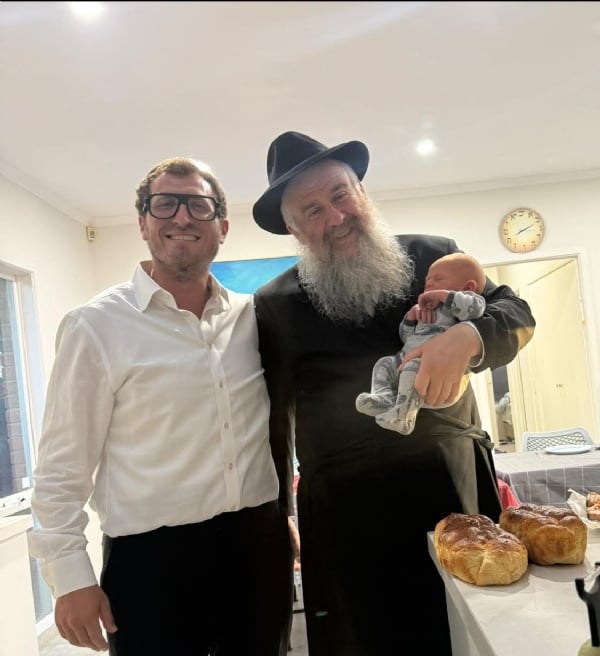
Early last week my wife and I landed in Melbourne last week on the eighth day of the birth of a new grandson to our eldest daughter Mushka, thank G-d. 


With my son in law, Rabbi Gabi Kaltmann and the new baby

For a Brit that we thought was scheduled but Hashem has other plans. The baby is jaundiced and according to Jewish law, in such conditions the bris – as important as it is - is delayed. 

The Rambam sums up the rationale for delaying this most central mitzvah of Brit Milah – the covenant between G-d and the Jewish newborn boy.

We should not circumcise a child who is afflicted with any sickness at all, since the danger to life takes precedence over everything. Circumcision can be performed at a later date, while it is impossible to bring a single Jewish soul back to life.

When the baby is in robust health please G-d within a few days, the Brit will take place in good health and spirit and with lots of joy (the Thailand grandparents will participate via zoom).

I was not bored on my trip. Alongside spending time with our family, the greatest nachas and pleasure thank G-d, Hashem had planned a full schedule of lecturing activities for me in Australia.

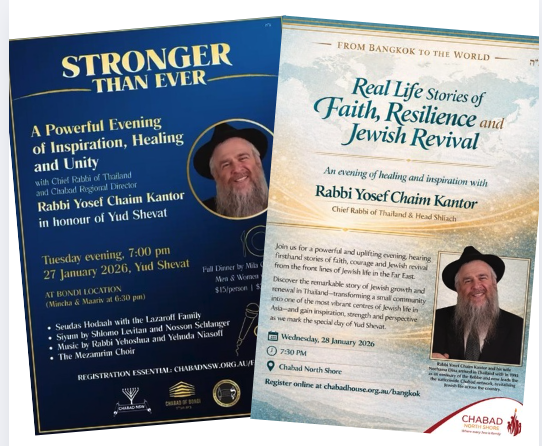
I traveled to Sydney and spoke at the Bondi Chabad House. It was at the thanksgiving meal for the recovery of the heroic Label Lazaroff who was heading back home to Texas after more than ten surgeries. 

Life is the most sacred and precious gift that we have from G-d.

I went to visit the Bondi Beach site of the Chanukah massacre. I saw the bridge that the shooter was situated on, the car park that the second shooter approached. The proximity between the shooters and the crowd was not far. 

It was horrific, tragic and enraging to see the site of this senseless barbaric act of terror.

I was inspired to see the gazebo and tefillin stand that has put on tefillin with thousands of Jewish men since the attack.

Click here for more.

The Rebbe’s response to darkness is to add light. The comforting can only come from the rebuilding. Bigger, better and more.

In this spirit the Chabad rabbi’s in Australia are working on opening new Jewish centers and generating more ‘semitism’ and Jewish life to bring more G-dly light into the world to drive away the darkness.

We, the Jewish nation, live in a constant state of waxing and waning. Like the moon that we are compared to. We have our difficult times, moments of challenge, yet we soldier on and do our best to fulfil Hashem’s Torah and Mitzvahs until the light comes blazing through. 

The next evening, I addressed the community in the North Shore of Sydney. On my way out of Sydney, I was invited to give a class to the high school boys of the Jewish day school on their first day of the school year.

In Melbourne I was the keynote speaker at the ‘Siyum Harambam’ celebration marking the completion of the cycle of learning the entire book of Maimonides, (in both the one year and three years cycle).

By learning the entire 14 books of Rambam, one essentially studies the mitzvah content of the entire body of the written and oral torah. All the mitzvahs are spelled out in this comprehensive work. 

The new cycle of Rambam study is starting tomorrow, Click here for more information and for the resources needed to join this study.

Please consider taking on this wonderful study so that you too can fulfil the mitzvah of learning the entire Torah.

(Here in Bangkok, we will be celebrating the Rambam study conclusion on Sunday at 18:30 in Bet Elisheva Synagogue). 

This week in the Parsha G-d gives the Jewish people the Torah.

MAZEL TOV to us all.

How fortunate we are to be the nation that Hashem chooses to be His special people, tasked with being a beacon and compass of Divine morality to the entire world. 

‘A light unto the nations’.

My dear friend, the Torah is YOUR inheritance.

It’s more valuable than the most expensive commodity imaginable. 

Make the best decision of your life. Spend a few minutes every day in Torah study.

Bringing G-d’s Torah into your mind, creates an intimate oneness between the Almighty and you. 

DI. not AI. Divine Intelligence. Nothing artificial about that. 

Even with just a few minutes a day. Your life will change for the better.

Shabbat Shalom

Rabbi Yosef Kantor

Looking for older posts? See the sidebar for the Archive.